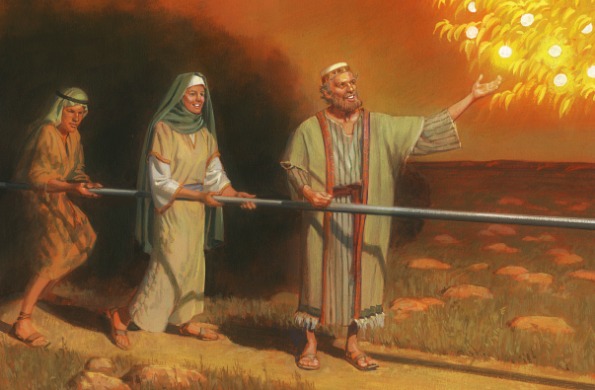
Abish and Spiritual Strength
Filed under: Book of Mormon Stories, People in the Book of Mormon
Abish was a woman who worked in the palace where Ammon, a popular Book of Mormon missionary, was temporarily serving the king as a shepherd. She had been converted but no one else in her community believed in the church and she had to keep her own testimony private. Despite having no friends who were members of the church, despite not having scriptures to read or a congregation to attend, she held on to her testimony and grew it. One day, after Ammon had saved the king’s flocks, the king called Ammon to him, and after being taught the gospel he was so overcome by the spirit he lost consciousness for several days. It was believed by everyone but his wife that he was dead and must be buried. The queen called Ammon to her and told him she believed her husband was still alive.
Ammon went to see the king and then told the wife her husband would rise the next day. He asked her if she believed him. Despite the fact that she’d not been a member of the church, she did believe, gaining an instant testimony. Ammon praised her great faith. The spirit was so strong, the queen and Ammon also lost consciousness. This was Abish’s great moment in history. She knew what was happening. She knew the Holy Ghost was present and that miracles were about to happen. Having so much faith, she wanted others to witness the miracle, so they would also be converted, so she ran to spread the word.
Things didn’t go quite as she planned, however. The people who gathered began to shout horrible things about Ammon, calling him a Nephite monster. Abish’s heart was broken and she cried. She went to the queen and took her hand. As she hoped, the queen awakened. The queen immediately began to call on the Savior to have mercy on her people, who were wicked. Then she took her husband’s hand and he awakened, and began to teach the gospel to the people. Then the real miracles began. Some people stopped shouting and listened. Some were converted and those who weren’t left the palace. Ammon eventually rose and also began teaching the gospel. Those who had stayed to hear the preaching asked to be baptized.
Many, many people were converted that day because a servant girl had maintained her testimony under difficult circumstances and had had enough faith to gather a crowd for the miracles she knew were to come. Abish, although not considered one of the major heroes of the Book of Mormon, is an amazing example of what can happen when only one person has faith and spiritual courage.
A Conversation of Truth . . . Being Black in the Mormon Church
Filed under: Home and Family, Self-Worth, Supporting the Priesthood
I had the wonderful opportunity of sitting down with a fantastic woman who has enlightened me in a number of ways. I decided I wanted to share with our LDSBlogs.com readers this daughter of God as well. So, please let me introduce you to Jewel Adams: wife, mother and author.
Candace: Jewel, you have made it very well known to one and all that you did not grow up in the Church of Jesus Christ of Latter-day Saints and that your circumstances were a little less than ideal. I happen to know you are a fantastic woman and someone I feel privileged to call my friend. But will you please share a little bit about your beginnings and what brought you to the Church in the first place?
Jewel: Well, I was born and raised in Asheville, NC. I lived in an abusive home and watched my mother be abused on a daily basis. I was a pretty messed up kid emotionally and because of this, I made some pretty poor choices. True, I had a painful childhood, but in the end, the choices I soon began to make were mine.
I made the dumb decision of getting married when I was 16 to a guy I didn’t love. I did it to escape the prison I called home because I was tired of taking care of an alcoholic mother. In truth, I just traded one prison for another. Two years later, Isaiah, the guy I married, went swimming and drowned. At 18 I was a widow and because of his life insurance, I had more money than I knew what to do with.
Having been raised poor, suddenly having that much money was not a good thing. That money helped to fuel a newly developing drug and alcohol addiction. It helped to numb all the pain that I couldn’t seem to forget.
Then I married another man I didn’t love (we only had drugs and alcohol in common). It was also at this time that I met my first set of missionaries. Of course a couple of minutes into the discussion they knew I was too wasted for them to get anywhere with me.
Two years later after family and friends had bled me dry and I was again living in a housing project but now was a mother of two babies, I was humbled enough for the Lord to send another set of missionaries and this time I listened, and I immediately knew what they were telling me was true. Despite an ongoing battle with substance abuse I was baptized. Because drugs and alcohol were the only thing we had in common, my marriage ended. I finally became clean and sober, married my amazing husband in the St. George Temple, moved to Utah permanently, and never looked back.
But thinking back on it, I think I was a Mormon as a child and just didn’t know it, I mean while all my friends idolized the Jackson 5, The Sylvers, and Marvin Gaye, I idolized The Osmonds. I had a poster of Donny on my wall and his face was on my notebook. Of course everyone thought I was out of my mind, but I didn’t care.
Candace: You are one of the least “woe is me” people I have ever had the blessing of meeting. With the recent Church celebration of the Lord’s revelation to President Spencer W. Kimball in 1978 that all “worthy male members of the Church may now hold the priesthood,” there has been much excitement and rumor abounding amongst the members of the Church. You’ve told me about your family, friends and co-workers’ opinions when you joined the Mormon Church. Will you please share those experiences and your responses to them?
Jewel: Growing up we didn’t go to church on a regular basis, but my mother did tell us about God and taught us to pray. When she finally escape her brutal marriage and we moved from Charlotte back to our home town of Asheville, my brother and I started attending church with my grandparents. They were staunch Baptists and their church rocked out every Sunday morning and evening. My grandparents wanted us to be baptized, but for some reason I refused.
Later when I joined the Mormon church I got a lot of flack from family and so-called friends. They gave me a hard time for joining what they considered a racist church. I told them the Church wasn’t racist. Then my manager at work asked me why the blacks had to wait so long to hold the priesthood. The answer quickly came to me. I said that neither the blacks or whites were ready for such a change before then and that a change of that magnitude would have torn the Church apart. It’s something I’ve never even questioned. There is a time for everything and God knows when that time is. He is perfect and He doesn’t make mistakes.
Candace: As an author, you have recently released a book which is a thinly veiled, yet wonderful, parable of premortality and mortality. As many know, Mormons believe we did not begin with birth, nor do we end with death. Would you please share your opinion and knowledge of how our Heavenly Father looks upon all of His children regardless of race, color or creed?
Jewel: First, I have to say that there is another author named Jewel Adams and her writing is kind of on the naughty side. That’s why I’m now going by J.Adams.
One of the things my mother taught us was not to ever see color, even though she was raised in an age of extreme racism. I’m sure that was a trait she brought with her to this life. I think Heavenly Father is color blind as well. I know each race has certain trials that may come because of their race, but like all other trials, I think what’s most important is how we deal with those trials, and how we let them affect us.
Candace: Would you please share with us what it is like being a black Mormon?
Jewel: When I first moved to Utah people actually went out of their way to show me they weren’t racist to the point that I would think, “Whoa, back up a little. I know you’re okay with me.” But truthfully, I love living in Utah among so many saints. I’ve never had a problem with cultural differences and no one has ever had a problem with mine. I’ve never had a problem with racism in the Church, and as far as I know, neither have my children. I have made so many friends in the Church, people who support me and love me unconditionally. My patriarchal blessing says that my “ability to make friends is a precious talent to be cultivated.” How grateful I am for that.
Candace: To those who would say The Church of Jesus Christ of Latter-day Saints is a racist church, how would you respond?
Jewel: I would say nothing could be further from the truth. Our church is filled with diversity and all are welcome, no matter your race, creed or color. We are all God’s children and we are all the same in His eyes. I’d also invite them to come and play church ball or attend a ward pot luck. Good food always brings everyone together.
Candace: What advice do you have other blacks investigating the Church?
Jewel: Put all thoughts of race and things of the past aside and open your heart so the Lord can do His work in it. And if you do have concerns, pray about them, but remember, it’s all about the gospel and nothing else.
Candace: I am a firm believer in celebrating that which is good and what we all have in common. Can you tell me why we should forget the hurts of the past and concentrate on the present and future?
Jewel: Concentrating on the hurts of the past can do nothing but bring us down. I’m a firm believer in showing gratitude for all things and living in the here and now. When I pray, I try to always remember to thank God for both the joys and the sorrows, including the sorrows of the past. I don’t know if my ancestors came from Africa, Fiji, or Jamaica, but I’m sure they were most likely slaves and were likely treated badly. But how grateful I am for what they went through. It is because of them that I am here in this free land, living this amazing life. Their time has passed, but my time is now, and I will not use this time thinking bitter thoughts. They would not want that.
Candace: What advice do you have for those seeking to find Jesus Christ and His Gospel?
Jewel: Just pray with an open heart, then listen with an open mind and ears, and He will come. And definitely welcome those missionaries.
Candace: Would you please leave your testimony with us?
Jewel: Looking back on my life and the person I was, I almost feel like I’m looking at someone else’s life, like I’ve lived two lives. How grateful I am to the Lord for rescuing me when He did. By rights I should be dead, but God had other plans, and if someone would have told me when I was 18 that I would one day be a Mormon, married and living in Utah, a mother of 8 children, and writing books, I would have offered that person a drink because they would have needed it more than me. But, as I said, God had bigger plans for me than I had for myself.
With all my heart and soul I know this gospel is true and I will be eternally grateful to the Lord for never giving up on me. I’m grateful for Jesus Christ and His atoning sacrifice. Because of it, I was able to leave the old life behind and accept the one I have now, the one He prepared for me from the beginning. And though I know I’ll never be perfect in this life, God has given me the gift of knowing that everyday is a day of grace as long as He is in it.
And there ends the interview with Jewel Adams. Much has been said of late of why African Americans join The Church of Jesus Christ of Latter-day Saints. Jewel has always been frank and straightforward in responding to people who ask this question. Once again, this morning she addressed this issue on an email list we both belong to. I asked her if she’d be willing to be interviewed for LDSBlogs.com and she was very gracious in saying yes. I hope you enjoyed this woman who has lived through so much to come out into the light of Jesus Christ. She is a friend who I would stand with at all times.
The Disciple’s Place in The Church of Jesus Christ of Latter-day Saints
Filed under: Becoming More Christlike, Humility, Obedience, Relationships, Service
What does membership in The Church of Jesus Christ of Latter-day Saints (sometimes called the LDS Church) mean for the disciple of Christ? Is it possible to be a disciple without membership? The most basic answer to the second question is yes of course. Anyone who realizes how important Jesus Christ is to them can begin a new life as His disciple. Emulating Jesus Christ is the best goal for anyone in this world. In fact, it is the primary purpose of our time on earth.
As we’ve discussed many times, discipleship is a growth process that allows us to be a little bit more like the Savior every day. The disciple of Christ truly desires to follow Christ, to carry His name, and serve those around him in the best ways he can. That process starts from wherever we find ourselves.
But, there is another factor involved in becoming a disciple. The disciple of Christ carries the Spirit of Christ within his heart and nature. It whispers guidance, assurance, peace, and understanding. It testifies of Jesus Christ and the eternal truths He taught. The disciple of Christ recognizes and embraces truth.
Because you are reading this blog, I know that you have had some dealings with the LDS Church. That may mean you are a life-time member or someone making a casual inquiry. Either way, the first question each of us found in this place, at this time, is: What do I believe about Jesus Christ? Then, after we’ve looked inside of ourselves and pondered our answers to this basic question we can move forward.
A belief in Jesus Christ is a foundation in good. It is the best place to build up a lasting part of ourselves. What we accomplish on this foundation carries the greatest value both here and in heaven. When we have established where we stand in our beliefs and love for Christ, we can move on to the next valuable question: What am I willing to do in His name? How can I best be His disciple? Again, these answers are individual.
The one thing that every disciple needs to keep in mind, both with their own dealings with their fellow man and in the way they view an organized religion of any type is: everything in the Church of Jesus Christ is about pleasing the Lord. Everything. Not politics, not station, not money, not prestige, not anything else.
Because of the light within me, because of my own desires to be a dedicated disciple, I recognize the truth that permeates The Church of Jesus Christ of Latter-day Saints but more importantly I recognize its focus. Everything in the LDS Church is about pleasing the Lord. That’s why this disciple chooses membership in a “peculiar” religion.
I have friends in many different religions. I hear their heartbreak as they watch members of their own congregations forget the most basic principles of discipleship. I do not pretend that there are no problems within our congregations. We are still human, but I think there is a very basic difference in how we operate and how many others do. We take our discipleship very seriously. We make covenants associated with our belief in Jesus Christ. We willingly enter into binding promises with our God to serve and honor Him. If something is happening that is contrary to the basic mission of pleasing God and supporting His doctrines it can, should, and will be corrected.
The Church of Jesus Christ of Latter-day Saints is a source of truth but most of all it is a source of commitment. I came because of Jesus Christ; I continue because of Jesus Christ, I try to please the Lord. If you’re ready to take your discipleship to the next level, let your heart look more closely at the truths that can be found here. It gives every member/disciple a chance to actively move closer to Christ in every way. It’s the best home I’ve found for the disciple of Christ.
Everything in The Church of Jesus Christ of Latter-day Saints is about Jesus Christ.
When Thou Art Converted
Filed under: Becoming More Christlike, Blessings, Humility, Obedience, Peace, Repentance, Service
Let’s look, for a moment, at one well-known scripture about conversion.
“But I have prayed for thee, that thy faith fail not: and when thou art converted, strengthen thy brethren” (Luke 22:32).

Do you recall when the Savior spoke these words? It was at the last supper. He was addressing His most faithful disciples yet He is praying for their faith and conversion. These were the men who had followed Him almost from the beginning, who had testified of His divinity, and still Christ felt they were not fully converted. For me, that brings to mind the question: what does it take for a disciple to be converted?
I think many of us assume that our conversion has already happened at the point in time that we declare ourselves to be disciples of Christ. I think the Lord would have us understand that is only the beginning. Think back to when you first came to understand how deeply you loved Jesus Christ, is that the last time you learned anything about Him? Were those the only poignant feelings you have had related to His gospel and teachings? Unless that first experience was yesterday, I rather doubt it was your last. I think this is one of the things that Christ would have us understand about faith, testimony, and conversion. It doesn’t happen over night. Conversion is an ongoing, dynamic process. Every day our souls weigh out our testimony as well as our commitment to the gospel and the commandments. If we’re on the right path to conversion, that balance comes out on the Lord’s side, not the world’s. With all our human faults, the goal of the disciple is to keep the balance weighing toward total conversion to the gospel.
There are many stories of conversion in the scriptures. These events are also often referred to as a change of heart or being born of God. Conversion means learning to imbed Christ and His teachings so fully upon our lives and hearts that we have no desire for anything else. The goal of discipleship is to reach this point of conversion.
I don’t know about you but like the disciples of Luke 22, I don’t think I’ve made it there yet. There are days (though I wished there were not) when I let my fears and doubts out-weigh what I know about the Lord’s divine mercy and watchful care over my life. There are days when discouragement at my own trials keeps me from noticing the needs of another. There are days when my testimony of prayer is strong, but my testimony of forgiveness is weak.
Conversion is more than knowing and declaring, it’s feeling and understanding. It’s becoming. Convert implies a complete change to something new and different than you were before. When we are converted, we become someone new, someone like the Savior. That type of transformation only comes when we take what we know and feel and continually turn it into doing and becoming.
Elder Dallin H. Oaks has said, “It is not . . . enough for us to be convinced of the gospel; we must act and think so that we are converted by it. In contrast to the institutions of the world, which teach us to know something, the gospel of Jesus Christ challenges us to become something” (Ensign, Nov. 2000, 32).
Another part of conversion is testing. As difficult as it may sound, the difficulties of this life are the refiner’s fires that can solidify our hearts in the ways of Christ. This is one of the things the disciples at the last supper had not experience yet. Yes, they had trials, but the Lord was always there. Their conversion would not be complete until they realized that they could follow Him even when they could not physically see Him. That’s the great mission and purpose of this life.
“Our needed conversions are often achieved more readily by suffering and adversity than by comfort and tranquility.” Dallin H. Oaks, “The Challenge to Become,” Ensign, Nov 2000, 32–34
As we weigh our daily progress toward conversion, it might be wise to review the words of Alma from the Book of Mormon.
14 And now behold, I ask of you, my brethren of the church, have ye spiritually been born of God? Have ye received his image in your countenances? Have ye experienced this mighty change in your hearts.
15 Do ye exercise faith in the redemption of him who created you? Do you look forward with an eye of faith, and view this mortal body raised in immortality, and this corruption braised in incorruption, to stand before God to be judged according to the deeds which have been done in the mortal body?
16 I say unto you, can you imagine to yourselves that ye hear the voice of the Lord, saying unto you, in that day: Come unto me ye blessed, for behold, your works have been the works of righteousness upon the face of the earth? . . .
19 I say unto you, can ye look up to God at that day with a pure heart and clean hands? I say unto you, can you look up, having the image of God engraven upon your countenances? . . .
26 And now behold, I say unto you, my brethren, if ye have experienced a change of heart, and if ye have felt to sing the song of redeeming love, I would ask, can ye feel so now?
Alma 5:14-26
The important thing to remember about conversion is that Christ is praying for us. He wants that mighty, and permanent, change of heart for each of us. Then, He wants us to share what we have learned and experienced with others.