Mormon Meetinghouses: Classrooms
Have you ever wondered what the inside of a Mormon church building looks like? You are invited to a virtual tour on an official Mormon website. Open it in another window so you can look around while reading my more detailed information here.
Take a virtual tour of a Mormon meetinghouse.
Each Mormon meetinghouse contains a large number of classrooms in various sizes. You’ve already seen the Relief Society and Primary. Today, we’ll visit a smaller classroom. On the map below the video, you’ll see a foyer. To the right of the foyer is an unlabeled silver dot inside a small room. Click the dot. This takes you to a classroom.
The classroom is very simple and undecorated, so it can be used by more than one class if needed. Teachers generally bring their own decorations each week, normally pictures or items related to the lesson, so nothing distracts from the topic. The room includes little more than a magnetized chalkboard, chairs suited to the ages of the students, a teacher’s chair, and a small table where the teacher can place her materials.
The teacher begins and ends class with a prayer. He or she teaches from a lesson manual prepared by the church, generally following a schedule. In most classes, you could show up in any church building and find the class exactly where your own class left off. This allows for continuity for travelers.
The teacher is always a volunteer. The Mormons have a lay church and there is enough work in their complex programs to keep everyone busy who wants a calling, as unpaid church jobs are known.
Read the lesson manuals taught by Mormons. The lesson manuals are available on the church website for anyone to read. This can be a good way to find out what Mormons teach members each week.
Let’s look at a sample lesson to see how a typical class might operate. We’ll use the following lesson:
This lesson was written for girls ages twelve to seventeen. They are usually taught in classes containing two age groups (12-13, 14-15, 16-17) and the lessons are adapted to the ages of the students. Each manual is taught twice, the second time at a more adult level, since the girls are now older. Two adult teachers, a member of the presidency and the class advisor, are present in each class. In the Young Women’s classes, all teachers and leaders are women. In the Young Men’s classes, all leaders and teachers are men. Sunday School is taught in mixed gender classes and the teacher may be either gender.
As you can see, the manual is designed so even an experienced teacher will be able to present an interesting and age-appropriate lesson. The teacher is encouraged to pray to determine the individual needs of her specific students as she prepares.
Each lesson offers an objective. This helps the teacher remain focused as she teaches. For this lesson, the objective is to help each young woman become a friend of Jesus Christ.
The lesson uses standard methods for quality teaching. To focus the girls’ attention on the topic, the teacher tells a story that helps them to understand knowing about Jesus is not the same as knowing Him. She then gives them a moment to contemplate where they stand in this story and then guides them through a discussion. A picture of Jesus knocking at a door is shown to end the discussion and return them to the topic. If you examine the picture carefully, you discover there is no doorknob. The message is that Jesus cannot enter your life unless you let Him in.
The girls are led through a variety of scriptures to help them learn more, which teaches them to turn to the Bible and other scriptures for gospel knowledge. They are also taught stories from the lives of church leaders and read the counsel of leaders to them, including this counsel, originally given to adult men:
“He wants us to come to him as we are. We do not have to be perfect to go to him. While Jesus was on the earth he associated with publicans and sinners and his disciples asked him why he associated with them, to which question Jesus gave a beautiful and simple answer: ‘They that are whole have no need of the physician, but they that are sick.’ (Mark 2:17.) The Lord does not ask us to heal ourselves of our imperfections before we approach him, but to come to him with those imperfections and he will assist us in overcoming them. The Lord loves us and wants us to overcome our sins and he will help us as we exercise our free agency. We must initiate the process of repentance and strive with all of our might to overcome our weaknesses” (Gospel Doctrine [A Course of Study for the Melchizedek Priesthood Quorums, 1970–71], p. 57).
The teacher then guides the girls through the process of reflecting on what they’ve learned so far to create a list of things they can do to draw closer to Jesus Christ. By developing this list themselves from the materials, they learn how to apply the lessons they learn to their personal lives, a skill which will help them throughout their lives.
The lesson concludes with testimonies from the teacher and classmates about the topic of the lesson, allowing the girls to learn from each other.
This lesson is typical of those taught at any age. Naturally, lessons for children include flannel board stories, puppets, and games, and adults might read more scriptures, but generally, students are taught basic principles of truth and then guided to apply them to their lives.
Teenagers probably receive more instruction than any other group. They have two Sunday classes. In addition, they have a weekday religion class taught during the school year. Most students attend this class, called Seminary, early in the morning. It involves an in-depth study of the scriptures for four years. Two of these years focus on the Bible. Once a week, they meet in the evening for a youth group meeting, which usually involves putting the gospel into action through service projects, learning practical skills, or educational but fun activities. The boys do Boy Scouts of America some weeks, while the girls have a similar program called Personal Progress.
In addition to all of these, they have an annual youth conference over two or three days and a summer camp. The teenage years are perilous, and Mormon youth are given a great deal of support to get through them.
In an earlier article, we learned the women spent the last class session in Relief Society. The men, during the same time, are attending their priesthood quorums, learning most of the same lessons, but focused on their roles as husband, fathers, and priesthood holders. Between the basic service and these gender-specific meetings is Sunday School, held in mixed gender classes for everyone ages twelve and older. Teenagers have their own classes. People who are visiting the church and are not members, or who are new members have a class of their own called Gospel Principles. This teaches them the essential aspects of the gospel at a beginner’s level, so they are prepared to understand the regular class after one year.
The adult Sunday School class is called Gospel Doctrine. A different book of scripture is studied each year in a four year rotation, on the same schedule as the teenagers and older children. Two years are devoted to a study of the Bible. One year is given to the Book of Mormon. The final year is spent on the Doctrine and Covenants, a book of modern revelation, and is combined with church history.
As you can see, Mormon churches are a busy place on Sunday. Of course, gospel study is not just for church meetings. Each member continues to study at home as well, because Mormonism is not a Sunday-only religion.
Mormon Meetinghouses: Baptismal Fonts
Mormon Meetinghouses: Foyer and Chapel
Have you ever wondered what a Mormon Meetinghouse looks like? Members of the Church of Jesus Christ of Latter-day Saints are often informally called Mormons, and many wonder what the inside of their churches look like. The
churches, unlike the temples, are open to anyone, including those who are not members of the Church, and are used for Sunday services, as well as for weekday activities. The church has filmed a virtual tour of a typical Mormon church building. The one shown in this tour is somewhat larger than most, and appears to be quite new. However, it would feel comfortingly familiar to any Mormon who walked in, since it looks much like every other Mormon church building.
Open the tour of the Mormon Meetinghouse in another window and look around. I’ll discuss some of the rooms here in more detail. By going to the map below the video, you can select any room you want to view.
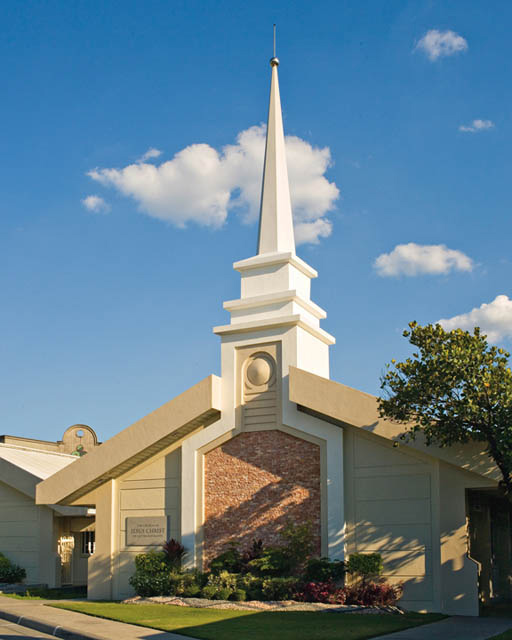
Begin by clicking the foyer. The tour starts you outside the building. Although Mormon buildings tend to have a similar look in most areas, you will sometimes find buildings that are quite different, due to age or to a need to blend with the neighborhood. Mormons work hard to be sure their buildings fit in and are neatly kept up. Members are encouraged to be good neighbors.
Mormons usually enter their buildings through the “back door” since parking is often tucked behind the building. When you enter, you find yourself in a foyer with a sofa and several chairs. People use this foyer to greet each other before meetings. During the weekday meetings, you’ll often find parents socializing or reading while they wait for their children. If you are visiting a Mormon church for the first time, you will find people here who will be happy to show you around and sit with you through the meetings. You’ll often find missionaries here (identifiable by their name tags) who can answer your questions and help you make sense of your visit.
Take a moment to look at the artwork in the foyers. Each foyer typically contains pictures of Jesus Christ or other religious scenes.
Follow the arrows to the chapel. If you entered from the parking lot, the chapel is normally straight ahead as you enter the foyer. You’ll notice, as you enter the chapel, it is very plain. This is a surprise to many who are used to ornate chapels. There are no crosses, artwork, or other decorations. A clock may be the only thing on the wall, and sometimes there will be flowers on the podium. Our complete focus during services should be on the Savior and on the speakers and events in the service, so there is little to distract us. This promotes a quiet feeling of peace.
The pews are normally padded and you may sit anywhere you like. You’ll frequently find young families situated near doors, because even the smallest child is welcome in our service. There is no nursery during this portion of the day. Children snuggle with their parents or play quietly, eventually learning to listen to the speakers. Occasionally a toddler will escape and rush to the choir loft, hoping to reach the piano before his parents reach him. Mormons take this sort of thing, along with the giggles of small children, in stride. It’s all part of being a family church.
The service is quiet and you are not required to stand or kneel. There may be an occasional intermediate hymn where members are invited to stand, but other than that you may remain in your seat. The meeting will begin with a welcome by a church leader from the pulpit at the front of the room, and will include announcements, prayer and a song. Following this is the passing of the Sacrament, bread and water which reminds us of the Savior’s atonement and is based on the Last Supper in the Bible. This is blessed (prayed over) by two men or older boys and then taken to the members by young boys, or, if there aren’t enough, adults. When the tray comes to you, if you prefer not to participate, simply take it and turn to the person next to you. Hold the tray while they take and eat their piece of bread or drink the small cup of water. They will then take it from you to pass to the next person. If you are at the end of the row, hand it to the boy waiting to collect it. Normally, this is for baptized members, but no one will stop you if you’d like to participate, as some do. You reach for a single piece of bread or cup of water with your right hand as it’s held by the person next to you. When you finish the water, place the cup in the center section of the tray.
After this, you will listen to speakers chosen from the congregation. Mormons have a lay church and the bishop, who is like a pastor, does not preach each Sunday. Instead, anyone age twelve or older might be asked to speak. Normally, one or two teenagers speak, followed by several adults, on an assigned topic. They write their own talks which include their personal experiences with the topic, as well as appropriate scriptures and quotes from leaders. Following this, the meeting will conclude with a song and prayer.
What you won’t see during the service is the passing of a collection plate. Tithing is paid privately by members, and is done by placing the donation and donation slip into a pre-printed envelope and handing it to one of three approved church leaders whenever the member happens to encounter him on Sunday. You will not be asked for money during your visit.
In the next article, we’ll follow members around as they leave this Sacrament Meeting and go on to their classes.
Mormon Meetinghouses: Relief Society and Primary Rooms
Filed under: Basic LDS Beliefs, Church Organization, Faith in God Program, Gospel Principles, Practices & Precepts, Scouting
Curious about what is inside a Mormon meetinghouse? Visitors are always welcome in these smaller buildings designed for regular worship and weekday activities. However, you can also tour a building virtually through a new feature on the Mormon’s official website.
Start the Mormon Meetinghouse tour. In the previous article, we explored the foyer and chapel and learned what went on during a service. Learn about the Mormon chapel.
Today, we’ll explore two special classrooms: The Relief Society and the Primary Rooms.
Look below the tour to see the map. The Relief Society room is in the top right hand corner of the map. This room is especially for women and is therefore, usually the prettiest room. It normally has nice curtains, attractive paintings, tablecloths, flowers, and other feminine touches. They are usually the only classroom provided with padded seats.
Mormons meet for three hours each Sunday. The main worship service lasts an hour and ten minutes. Following this, the families go in various directions, with adults and teens having two classes to attend, and children attending their own program. Relief Society is normally held the last hour and is only for the women. The organization was founded in 1842, and centers around providing service to others. On Sundays, the women meet for a class that is especially tailored to the particular lives and needs of women. Some weeks they study the same topic as the men, but with a feminine focus if there is one. Other weeks, they study unique topics. Lessons are drawn from teachings of past church leaders, talks given in semi-annual conferences from current church leaders at the international level, and topics of special interest to women.
During the week, each Relief Society may choose to have special clubs, classes, or meetings to help women perform service, learn new skills, and pursue hobbies and friendships. Examples might include a mom and tots group, a blogging club, a humanitarian aid group, lessons in car and home repair, or craft programs. The choices are as diverse as the women themselves, and vary based on the interests and needs of each group.
A unique feature of the Relief Society is the visiting teaching program. Women, working with an assigned partner, are given three or four other women to visit monthly. They come to the home with a brief spiritual message to discuss, and they also work to build a friendship with these women. They are charged with watching for needs the church can fulfill and are the first person a woman calls when she needs help. A visiting teacher will then either provide the service, or help to find someone who can. For instance, a visiting teacher might bring in a meal when the sister (the Mormon form of address for adult women) is ill, watch her children when she has a doctor’s appointment, or alert leaders the family has nothing to eat. It is reassuring to women to know there is someone they can call when they need help or just a friend.
The Relief Society also operates a literacy program that is tailored to whatever needs the congregation might have. Some groups use a church program to teach reading. Others teach English to immigrants, tutor inner-city children, or help people learn to write their personal and family histories.
Now go back to the map and click on the Primary room, found in the bottom right hand corner. This room belongs to the children of the church, ages three to twelve. In most wards (congregations) the children are divided into two groups, Junior Primary and Senior Primary, with age eight being the dividing line. They will meet in the Primary room all together for opening exercises. During this time, they have a prayer, songs, a scripture and a talk given by a child. Even a three-year-old might stand at the pulpit on a step that allows him to reach the microphone, and give a two and a half minute talk on a gospel principle with the help of a parent. This allows children to learn from their peers, and also helps the children learn poise, confidence and public speaking skills, while encouraging him to share his thoughts on an aspect of his faith.
Following this, most Primaries send the older children off to age-divided classes. Their classrooms are small and usually contain a chalkboard, bulletin board, and chairs sized to the students. The teacher prepares a lesson from a manual that can be read online. Read the lesson manuals used to teach Mormon children.
These older children are called Valiants. They have been baptized and are learning to be valiant in keeping the baptismal covenants (promises) they made to God. Mormon children are baptized at age eight. The lessons are taught through the scriptures, and they follow the same four year plan as their parents and teenage siblings, allowing families to discuss together the scripture stories learned. The children spend two years learning the Bible, one learning the Book of Mormon, and one learning church history and the Doctrine and Covenants. This last book is a collection of revelations received in modern times.
After their lesson, the children return to the Primary room for Sharing Time. The younger children, who were already having sharing time, go to their own classes. The younger children are called CTRs, which stands for Choose the Right. They are preparing to be baptized and are learning enough about their religion to make a wise choice and are also learning to become like Jesus. In their lessons, they follow a two year program. When it is repeated, they are more mature and can handle the same lesson taught at a higher level. They spend one year on the Bible. The second year covers the Book of Mormon and the Doctrine and Covenants.
Also included in Junior Primary are the Sunbeams, who are three at the start of the year. Their lesson manual is used for only one year and contains stories from all the scriptures taught in simple ways.
In Sharing Time, the children receive a fifteen minute lesson from a member of the Primary Presidency, a group of three women who run the program. There is a theme for the entire year, such as “I Am a Child of God” or “I’m Trying to Be Like Jesus.” Each month, they study an aspect of the theme during Sharing Time. They also have fifteen minutes of singing with a music leader. Much of this music is focused around the theme as well. Near the end of the year, the children do a program for the entire congregation, taking over the regular service to sing and to teach the adults what they’ve learned.
The Primary room has chairs in a variety of sizes placed in rows. Children sit with their own classes and teachers. It usually includes a piano and pictures of Jesus with children. There is a chalkboard and decorated bulletin boards.
The Primary oversees a nursery, as well. This is for children who are eighteen months old to age three. If they are three years old January 1, they graduate to the Sunbeam class. This is not just child-care. It is a true class. The children have a lesson manual with simple lessons that teach them about God and Jesus in easy to understand ways. They generally have about ten minutes of lesson time, a fifteen minute singing time, crafts, group play, stories, and a play time. At least two teachers are present at all times.
Senior nursery children have weekday programs. The boys participate in Cub Scouts and the girls have a similar program called Activity Days.
In the next article, we’ll learn about the Youth program for teenagers, and about the cultural hall.
The Golden Rule and Civility
While living on Earth, Jesus taught what has come to be known in the Christian world as the Golden Rule. “Therefore all things whatsoever ye would that men should do to you, do ye even so to them: for this is the law and the prophets.

Discipleship (Good Samaritan)
(See Matthew 7:12.)
For members of The Church of Jesus Christ of Latter-day Saints, whose members are sometimes called Mormons, this penetrates every aspect of our lives. It is not an instruction just to be obeyed during church. While it seems easy in theory to practice this, in everyday life, it can be challenging to remember it in the heat of battle.
Recently, the Mormons released a plea for a return to civility in both public and private life, centered on the principle of the Golden Rule. The Mormon Ethic of Civility was a firm reminder that civility is a Christ-like principle applicable to all aspects of life. “Latter-day Saint ethical life requires members to treat their neighbors with respect, regardless of the situation. Behavior in a religious setting should be consistent with behavior in a secular setting.”
The statement focused in on politics, one place where even the kindest person might find civility to be a challenge, as he is faced with very strong opinions on how his nation ought to function. Church leaders reminded members the church is non-partisan and that it defies categorization into any single party. Leaders encouraged members to look to the Church’s example in deciding how to approach this challenge:
Civility is not only a matter of discourse. It is primarily a mode of engagement. The technological interconnectedness of society has made isolation impossible. Of all the institutions in the modern world, religion has had perhaps the greatest difficulty adjusting to the reality of give and take with the public. Today, and throughout its history, The Church of Jesus Christ of Latter-day Saints continuously encounters the legitimate interests of various stakeholders in its interaction with the public. Rather than exempting itself from the rules of law and civility, the Church has sought the path of cooperative engagement and avoided the perils of acrimonious confrontation.
A careful study of the Church’s commentary section in the LDS Newsroom can be enlightening for Mormons and others who wish to learn how to tackle controversial topics in a civil manner. While never shying away from proclaiming truth, and while calling for respect, they tackle attacks and sensitive issues in a Christ-like manner and all can benefit from studying their approach.
In a previous release called “The Publicity Dilemma,” the Church offered this counsel:
As Elder M. Russell Ballard and Elder Robert D. Hales of the Council of the Twelve Apostles have both said recently, when expressing themselves in the public arena, Latter-day Saints should conduct themselves with dignity and thoughtfulness.
Not only is this the model that Jesus Christ taught and demonstrated in his own life, but it also reflects the reality of the strength and maturity of Church members today. As someone recently said, “This isn’t 1830, and there aren’t just six of us anymore.
The call for civility referred Mormons to The Book of Mormon, which tells the history of a civilization that revolved often from prosperity to decline. The negative stages of the cycles always began with a decline in civility. Church leaders are concerned about the impact negative political behavior—lying, name-calling, and attacking, rather than polite expressions of opinion and a spirit of cooperation–will have on our nation.
Furthermore, the Church views with concern the politics of fear and rhetorical extremism that render civil discussion impossible.
This is not a new topic for the Mormons. Church leaders have spoken forcefully on this subject in the past. They warn of the dire consequences that can occur when civility is abandoned in favor of less Christ-like methods of politics. One Church leader pointed out we are endangering our entire democratic system when we focus on the negative.
Tirades against men in office or against one’s opponent tend to cause our youth and others to lose faith in the individual and others in government and often even our form of government itself.” (See N. Eldon Tanner, “‘Judge Not, That Ye Be Not Judged’,” Ensign, Jul 1972, 34.)
Gordon B. Hinckley, a former prophet of the Mormons, warned that while we can’t ignore the problems in our nation, we can control where we focus our attention and how we speak. In his mainstream book, Standing for Something, he warned everyone to search for balanced truth and to avoid cynicism. “A sustained diet of a negative point of view has serious repercussions,” he warned. He said such a method for coping with the challenges of the world created a cloud over the nation and made it difficult to find truth. “But if we will turn our time and our talents away from vituperative criticism, away from constantly looking for evil, and will emphasize instead the greater good, America will continue to go forward with the blessing of the Almighty and stand as an ensign of strength and peace and generosity to all the world.” (Hinckley, Gordon B.. STANDING FOR SOMETHING -. New York: Granite Publishers, Inc, 2006. Pgs. 102-103.)
By accepting the Mormon call to civility, we can avoid negativism, and continue to receive God’s blessings over our nation. We need only turn around the question: How would I feel if these words and this method of handling issues were turned against me? How would I want someone who disagreed with me to treat me and to handle the disagreement? The Golden Rule is an infallible way to handle politics wisely, allowing members to be actively participating citizens in the democratic process while maintaining their position as representatives of the Savior.
God’s Diversity of Gifts
Filed under: Doctrine & Covenants, Finding joy within the gospel, Gospel Principles, Practices & Precepts, LDS Practices, Men & Priesthood, Priesthood, Priesthood, Self-Worth, Service, Uncategorized, Women
Mormon scriptures teach that every person God creates is given gifts, talents, traits, and experiences from Him, to be used to help others, as well as to bless our own lives. They are His gifts to us. What we choose to do with them is our
gift to God. It does no good, for instance, to be given a gift to teach powerful spiritual messages if we refuse to learn about Jesus or turn down an opportunity to teach Sunday School.
11 For all have not every gift given unto them; for there are many gifts, and to every man is given a gift by the Spirit of God.
12 To some is given one, and to some is given another, that all may be profited thereby. (See Doctrine and Covenants 46: 11-12.)
Everyone, male and female, can receive spiritual gifts. The scriptures list many of these gifts, and it can be interesting, as we read, to highlight each gift mentioned. The gifts bless the holder of the gifts if he uses them wisely, but they can also be used to bless others. A person who has the gift of faith can use it to find the truth among conflicting and confusing choices. This gift can be used to help that person become a member of the Savior’s church. It comes to her through the Spirit of Christ. After receiving the Gift of the Holy Ghost, her faith grows even more. She might then choose to use that gift to pray for others or to share her faith with those who were not given as strong a gift as she received.
We’re taught that it is appropriate to pray for certain gifts, if we are prepared to use them wisely in the service of others, rather than to glorify ourselves. A person who is invited to teach a class, but lacks the gift to teach can begin to pray for it. While praying, of course, she must do what she can to improve her teaching skills, but God will step in and honor righteous requests if they are part of His plan for us. A prayer to become the greatest teacher in the world is not likely to be honored, because this is a prideful request, but a prayer to have the ability to teach the class one has agreed to teach will be honored.
The diversity of the human race is one of God’s best ideas. If we all had the same talents, gifts, and assignments, most things wouldn’t get done. The world needs writers, but it doesn’t need everyone to be a writer. It needs gardeners, but everyone doesn’t need a talent for gardening. Because each of us has different talents and passions, everything that needs doing gets done. If we each had all the talents possible in equal proportion, we might find ourselves spread too thin, and most things wouldn’t get accomplished. We’d all be doing whatever was easiest or created the most wealth, given human nature.
In the same way, God divided up certain tasks and assigned them to specific genders. Only women were given the ability to give birth. This doesn’t mean God loves men less; it only means that doesn’t happen to be one of the tasks assigned to them. Only men hold the priesthood, but that does not say women aren’t worthy or capable of holding it. Priesthood is an office, not a gender, but assigning it to men keeps it focused, just as assigning childbirth only to women keeps that aspect of life focused.
Within the Mormon Church, there are a great many tasks to be completed, because we have a lay religion and very complex programs. Everyone is asked to take on his or her share of the work. Tasks are assigned in various ways that make the church run more smoothly. Some are assigned by age: Only a twelve or thirteen year old girl may serve as a youth leader in the Beehive Program. (Beehives are girls of that age in the Young Women’s program for teenagers.) Others are assigned by gender: Only women can serve as Primary or Relief Society Presidents. (These are, respectively, the organizations for children and women.) Some tasks are open to anyone who is an adult: Anyone may teach the children or the literacy classes, even though only women can lead those programs. Some tasks are assigned by office: Only a person who holds the office of a high priest can serve as a bishop (the leader of a congregation.) It might appear that the rule is that only men can be bishops, but actually, the rule is that only high priests can be bishops. A good and worthy man who does not hold the office of high priest in the priesthood cannot be a bishop, no matter how qualified he is otherwise.
While it’s true that only men are to hold the Mormon priesthood (as we see from even a casual study of the Bible), this does not limit a woman from serving God, anymore than not being able to be the Primary president limits a man’s ability to serve God. There are many ways to serve, and God does not love the priesthood holders more than the Primary president—or the door greeter. We don’t get bonus points for serving in certain kinds of positions. God asks us to serve wherever He needs us, and if we do this well, we are blessed for our attitude and willingness to serve, not for the specific task accomplished.
Men holding the priesthood receive no special blessings over the women. It isn’t about power or blessings, or God’s love. It is, rather, about our trust in God and His plan. If we have a testimony that the Savior is at the head of the church, and that He sees with a vision greater than our own, we won’t waste valuable mortality hours fretting over what gifts or offices we don’t have. Instead, we’ll work hard to develop those God has asked us to take on. As with every other aspect of the gospel, it really comes down to a testimony. How much do you trust God?
When I was first investigating the church, the priesthood issue concerned me. As a teenager raised in the 1970s, I thought women’s lib was what I was supposed to be living, even though I was known for my love of taking care of children. In other words, my nature was fairly traditional, if you leave out housework. The missionaries, when asked about priesthood at the first lesson, told me they’d be happy to discuss it with me, but I needed more background and training in prayer first. They asked me to learn to pray, and to continue to study, and then we’d discuss it. By the time I was able to understand the answers, I no longer needed to ask the question. I had learned to get my own answers through prayer and I had come to see how much God valued the woman’s place in His kingdom. I understood that being told I had to turn into a man was degrading to women and insulting to God, who created gender. It was no longer a problem for me. I had become proud of the person God created in me.
Over the years, I’ve longed for certain gifts. Some I’ve been able to receive, such as an improved ability to teach. Others were not my calling, such as a desire to sing. Over the years, as I’ve grown and matured, I’ve stopped wasting time fretting over what I don’t have, and have begun to be thankful for what I do have. God gave me a most interesting gift box of traits, talents, and experiences. I would be ungrateful and unworthy of those gifts if I wasted my life whining they weren’t good enough.