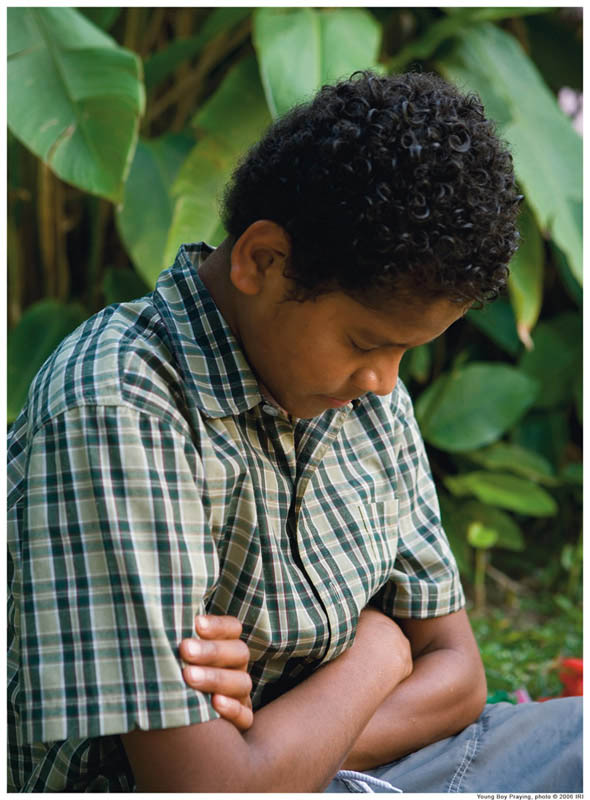
Achieving True Reverence
Filed under: Becoming More Christlike, Jesus Christ
Robert C. Oakes, who served as a member of the Seventy (a high level position in the Mormon Church) for many years
recently wrote about the subject of reverence, suggesting it is not just a topic for children. Reverence is an important part of worship for all followers of Christ.
When I teach young children, I often ask them what it means to be reverent. They normally respond, “Sit down and be quiet.” Teachers often tell children to be reverent when they really mean to tell them to behave, and so this is the definition most children have of the word. I follow up by asking them to listen to a story:
Susan is sitting in Primary (the children’s auxiliary in the Mormon Church) and is sitting very still. Her hands are in her lap, she isn’t talking, and she isn’t wiggling. She’s looking right at the teacher. Is she being reverent? The children say she is. Then I tell them there is more to the story. While she’s sitting still, not talking, not wiggling and looking at the teacher, she is thinking, “When I get home, I’m going to hit my brother. He was so mean to me this morning. I’m going to teach him a lesson.” I ask again, “Is Susan being reverent?” Even young children realize she is not being reverent, because although her body is doing the right thing, her mind is not.
I tell the children behavior is on the outside and reverence is on the inside. Then we sing a children’s song that emphasizes this message:
Rev’rence is more than just quietly sitting:
It’s thinking of Father above,
A feeling I get when I think of his blessings.
I’m rev’rent, for rev’rence is love. (Listen to Reverence is Love.)
Reverence is how we show our love for God and for Jesus Christ. Mormon churches have foyers meant for the inevitable socialization among a people who consider their congregation their second family. Once they enter the chapel or a classroom, they’re asked to stop socializing and to sit quietly, listening to the prelude music. Of course, that doesn’t always happen, but it’s the goal.
During the meeting, members remain quiet, listening to the speakers and doing whatever is needed to keep small children happy. In a Mormon church, even the tiniest child remains with his family during the main worship service, known as Sacrament Meeting. This allows children to be trained by their parents to be both reverent and well-behaved, and includes them in the spiritual life of the congregation.
True reverence, as mentioned above, is not just about sitting still and being quiet. While it’s certainly easier to feel the spirit when we’re well-behaved, our minds must also be focused on things of the spirit. As we walk through the chapel doors, we leave behind us the cares and thoughts of the world, and turn our full attention to God. In the quiet moments that are ours, we think of the Savior and His atoning sacrifice, and during the time people are speaking, we listen carefully and stay alert for promptings from the Holy Ghost as to how the speaker’s message can apply to us in our own lives.
This three hour focus each Sunday on the things of the spirit helps Mormons to move into the outside world renewed and ready to face the moral and secular challenges of everyday life. We feel ready to tackle life and the gospel with renewed strength and energy.
Of course, Church isn’t the only place reverence is needed. We can feel the spirit every moment of our lives if we work hard to do so. As we go about our weekday chores and tasks, we can surround ourselves with things that will help us keep the Holy Ghost near. Playing spiritual music, thinking about the gospel and how to apply it to each aspect of our lives, and reading appropriate books ensure the spirit will be present. Mormons are taught that when the Spirit flees, they must flee also, and the Spirit cannot be where there is sin. Mormons work to create an appropriate environment for themselves whenever possible, decorating their homes with spiritual things among the secular ones, playing appropriate music, interacting kindly to family members, and engaging in service and other appropriate activities.
They try to bring the gospel into their homes as much as possible. Each morning they have prayer and scripture study. They have a spiritually based family night once a week. They select other gospel-centered activities to do throughout the week, ensuring that their religion is not a three-hours-on-Sunday religion, but an all day, every day religion that impacts every moment of their lives.
There are times, of course, when we cannot control our environments, such as at work or school. However, we can choose how we interact with that environment. We do not need to participate in gossip or gripe sessions. When inappropriate music is playing, we can move to another room, encourage a change of music, or put on headphones where allowed. If all else fails, we can tune out or ask to be placed in a less offensive environment.
While we can’t always control the music or the language around us, we are always in full control of our own thoughts. We can fill our minds with religious music, spiritually uplifting thoughts, and a pleasant attitude. It’s what we do with what we can control that determines the presence of the spirit.
Elder Oaks explained, “As we study the life and teachings of Jesus Christ and gain an appreciation of the remarkable impact—both mortal and eternal—of His Atonement on our lives, we naturally experience the emotional responses of respect, love, and honor. Gospel obedience and Christian service then flow as appropriate expressions of these emotions. But without reverence, the expressions of respect, love, and honor are incomplete.
As we develop reverence for Jesus Christ, we are better able to pattern our lives after His perfect example. There are many facets to such reverence: faith that He lives, trust in His promised blessings, and obedience to gospel standards. But one of the most important facets is the feeling of our heart—the respect, love, and honor we feel toward Deity. We who respect, love, and honor the Lord will never take His name in vain and will be uncomfortable with demeaning or trivializing jokes about Him. Rather, we praise and revere our Heavenly Father and Him whom we worship as our Lord and our Savior.
The Lord gives clear direction regarding His expectation for reverence in Leviticus 19:30, where He states, “Ye shall keep my sabbaths, and reverence my sanctuary: I am the Lord.” The respect we show for His temples and chapels is a reflection of the reverence for Him we feel in our hearts. Our degree of respect, love, and honor for the Lord is directly reflected in our reverence, as shown by our attitudes as well as by our decorum.” Robert C. Oaks, “Worship through Reverence,” Ensign, Dec 2009, 20–23
The Power of Music
In the December 2009 issue of the Ensign (a magazine for adult Mormons), Russell M. Nelson writes of the power and protection of music. Elder Nelson is an apostle, a high-ranking Mormon leader and, prior to full-time church leadership, was a doctor. He recently spoke to young single adults on music, and how it can protect us and about the power it can have for either good or evil.
Music is an important part of Mormon life. From the much loved sounds of the Mormon Tabernacle Choir to the sweet
voices of young children singing in their Primary Program, music fills the worship and the lives of Mormons. They are taught from an early age that music can both protect them and teach them. It has the power to build testimonies, as it seems somehow to reach deep into the hearts of those who listen or sing.
A few years ago, I attended a stake conference. A stake conference is a meeting of a number of different Mormon congregations in a geographic area. The children throughout the church had been learning a song that year about the power of reading scripture. The stake president asked all the children to stand wherever they were and sing the song for the adults. To help them, a music leader stood in the front holding up pictures representing the meaning of each part of the song. In one part of the song, the children sing that if they read the scriptures and obey the teachings found therein, they will receive a great reward. The music leader, on the words great reward, held up a picture of Jesus Christ. A child standing in front of me suddenly lit up and said excitedly, “Oh, that’s the reward!”
This story illustrates the importance of making certain our children—and we ourselves—understand and think about the words we sing each Sunday in our worship services. Unless we know what we’re singing, and think about the meaning of those words, the songs cannot reach our souls.
Music can serve as a protection for us as we attempt to live our lives according to the teachings of Jesus Christ. Mormon children learn a song in which they sing that if they’re tempted to say a bad word, they can hum a hymn, allowing them to fill their minds and hearts with the gospel of Jesus Christ instead of inappropriate thoughts. Often, as we’re tempted to do something wrong, a hymn we’ve spent a great deal of time with will suddenly come into our minds and remind us that life is more than brief moments of worldly pleasure. We can train ourselves to have these thoughts come to mind by choosing to sing them in moments of weakness.
When we surround ourselves with quiet appropriate music, whether it is spiritual or simply quiet and uplifting, we are better able to feel the Spirit and to receive promptings and inspiration. A home that is playing soft, spiritual music invites the Holy Ghost to be present and minimizes fighting and poor choices.
Elder Nelson warns young people to be careful about the type of music they select:
Wherever we are we should carefully choose what we see and hear. We would not knowingly tolerate pornography in our homes, but if we are not careful, we may allow music into our lives that can be just as devastating.
Many youth listen to music that can be described as loud and fast, becoming louder and faster. It aims to agitate, not to pacify; to excite more than to calm. Beware of that kind of music.
As you know, continued exposure to loud sounds will, in time, damage delicate organs of hearing. In like manner, if you overindulge in loud music, you will more likely become spiritually deaf, unable to hear the still, small voice. A scripture states, “The Lord your God … hath spoken unto you in a still small voice, but ye were past feeling, that ye could not feel his words” (1 Nephi 17:45).
Do not degrade yourself with the numbing shabbiness and irreverence of music that is not worthy of you. Delete the rubbish from your minds and your MP3 players. Protect your personal standards! Be selective! Be wise!
Do not allow unworthy, raucous music to enter your life. It is not harmless. It can weaken your defense and allow unworthy thoughts into your mind and pave the way to unworthy acts. Please remember:
“That which doth not edify is not of God, and is darkness.
That which is of God is light” (D&C 50:23–24).
Fill your minds with worthy sights and sounds. Cultivate your precious gift of the Holy Ghost. Protect it as the priceless gift that it is. Carefully listen for its quiet communication. You will be spiritually stronger if you do.
You know the proverb, “As [a man] thinketh in his heart, so is he” (Proverbs 23:7). As you control your thoughts, you control your actions. Indeed, worthy music can provide power and protection for the soul.” (See Russell M. Nelson, “The Power and Protection of Worthy Music,” Ensign, Dec 2009, 13–17)
Children will learn to love quality music if they hear it from the time they are small. We can help them learn to love it by using hymns as lullabies, singing it as we work, having family singing, and by playing it periodically throughout the day. They will learn to value its power if we demonstrate how it can help. A frightened child can be encouraged to join a parent in singing a comforting hymn. When a child is facing a problem, a parent can ask, “Do you know a hymn that answers that question? Let’s sing it together.” By referring to hymns when we’re facing trials, or including them in our celebrations, children will learn how to make the hymns more than just a break in the sermons, but will see them as an essential tool for a Christ-like life.
Gratitude as a Path to Happiness
In difficult economic times, it might seem hard to make a Thanksgiving list of things we’re grateful for. However, no matter what our circumstances, there are always things to add to our list.
We are children of a loving Father in Heaven. That is the first item to place on any list. The second is that His Son, Jesus
Christ, loved us enough to die for us. These two blessings can serve as the foundation for all other blessings on our list. Some things cannot be taken from us, no matter how little income we have or how few our possessions.
In the May 2000 Ensign, a talk given by Bonnie D. Parkin in the Mormon General Conference, talked about gratitude during even the hardest of times. (See Bonnie D. Parkin, “Gratitude: A Path to Happiness,” Ensign, May 2007, 34–36.) She suggested showing gratitude toward Heavenly Father for our blessings was one way to find happiness in our trials.
Sister Parkin said, “Let me share a sweet story with you. A family was going through a difficult time. It was hard for them not to focus on their challenges. The mother wrote: “Our world had completely crumpled, so we turned to Heavenly Father for guidance. Almost immediately we realized that we were surrounded by goodness and were being cheered on from every side. We began as a family to express our gratitude to each other as well as to the Lord daily. A close friend pointed out to me that our family’s ‘blessing basket’ was overflowing. From that conversation came a sort of game, which my children and I grew to love. Before family prayer each night we would talk about how our day had gone and then share with each other all of the many blessings that had been added to our ‘blessing basket.’ The more we expressed gratitude, the more there was to be grateful for. We felt the love of the Lord in a significant way as opportunities for growth presented themselves.”2
What would a “blessing basket” add to your family?”
We often have no control over the trials we’re given. They come to us through our own choices or through the choices of others. Sometimes we can work to improve the situation, but other trials are outside our control. However, we can control how we view those trials and we can control where we focus our attention. Certainly, some trials require a great deal of our attention, but others must simply be gotten through. With either type of trial, we can focus exclusively on the negative portions of the trial, or we can give time as well to the good things going on in the background. Every day of our lives, something good is happening to us. When we pay attention to those good things and remember to take a few minutes to thank God for them, somehow the trials don’t seem as overwhelming. We’re able to see God’s presence in the worst of times, and to remember there will always be goodness during bad times.
“Gratitude requires awareness and effort, not only to feel it but to express it. Frequently we are oblivious to the Lord’s hand. We murmur, complain, resist, criticize; so often we are not grateful. In the Book of Mormon, we learn that those who murmur do not know “the dealings of that God who … created them.”3 The Lord counsels us not to murmur because it is then difficult for the Spirit to work with us.
Gratitude is a Spirit-filled principle. It opens our minds to a universe permeated with the richness of a living God. Through it, we become spiritually aware of the wonder of the smallest things, which gladden our hearts with their messages of God’s love. This grateful awareness heightens our sensitivity to divine direction. When we communicate gratitude, we can be filled with the Spirit and connected to those around us and the Lord. Gratitude inspires happiness and carries divine influence. “Live in thanksgiving daily,” said Amulek, “for the many mercies and blessings which he doth bestow upon you.”4
Mercies and blessings come in different forms—sometimes as hard things. Yet the Lord said, “Thou shalt thank the Lord thy God in all things.”5All things means just that: good things, difficult things—not just some things. He has commanded us to be grateful because He knows being grateful will make us happy. This is another evidence of His love.”
The Book of Mormon, a book of sacred text used by Mormons alongside the Bible, tells of a man named Nephi. He wrote that he had been blessed all the days of his life. This might seem to be an unimportant, generic sort of expression until you realize those days of his life had been filled with trials that would do in the average person. As a young teenager, he had to flee his home with his family due to persecution, and leave for a strange new land. He was homeless for many years as he traveled through the wilderness. His two oldest brothers regularly abused him and even attempted to kill him numerous times. When his parents died, he, his family, and his supporters fled persecution and danger once again—this time escaping his oldest brothers.
And yet, despite a lifetime spent in a highly dysfunctional family and despite constant danger, he felt all—every one—of his days had been blessed. While he faced homelessness, he was never alone. While he faced abuse and attempted murder, he was always saved by angels or God’s power, and he always had the portion of his family that believed in him behind him. He seems to have focused his attention on the blessings, rather than the trials of his life. Certainly he couldn’t ignore the trials—it’s hard to overlook attempted murder—but they didn’t define his life in his own mind. Instead, he made a special point of noticing and expressing gratitude for the good parts.
Sister Parkin explained the blessings that come from a lifetime of choosing gratitude: “The kind of gratitude that receives even tribulations with thanksgiving requires a broken heart and a contrite spirit, humility to accept that which we cannot change, willingness to turn everything over to the Lord—even when we do not understand, thankfulness for hidden opportunities yet to be revealed. Then comes a sense of peace.”
Read “Gratitude: A Path to Happiness.”