
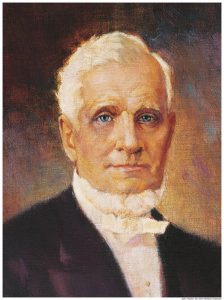

John Taylor: Obedience Through Trials

July 20, 2010 by · Leave a Comment
Filed under: Prophets 

John Taylor, third prophet of the Mormon Church, was born in the Westmoreland part of England in 1808. His parents were his first teachers, helping him learn to read. They also gave him faith in God and an understanding of the Bible and of the Savior. He was baptized as an infant into the Church of England.

John Taylor, Mormon prophet

John Taylor, third

However, when he was a little boy, he had a vision. He saw a man holding a trumpet in his mouth. The man was in the heavens and the trumpet was an announcement of some sort, but he didn’t understand what this meant. As a child, when he was alone, he frequently heard soft music that seemed to be coming from heaven. He kept all these things in his heart.

When he was sixteen, he converted to the Methodist religion and only a year later was made a lay preacher. He had strong spiritual impressions that God intended him to teach the gospel in the United States some day.

However, it wasn’t to the United States that he moved first. First, he immigrated to Toronto, Canada. His family went ahead and he joined them when he finished selling the family property and wrapping up business. On the ship, he received another spiritual prompting as God continued to prepare him for what was to come. A terrible storm arose, frightening everyone. However, John felt the spirit tell him again he must someday go to the United States to preach the gospel. Because of this, he knew he would arrive safely, and was so sure he even went up on deck to enjoy the storm that was terrifying his shipmates.

He lived in New York for a few months on his arrival and then joined his family in Canada, where he soon married another Canadian immigrant, Leonora Cannon. John Taylor was still deeply committed to religion and he and a group of people decided to get together regularly to study religion. Their study turned out to be unsettling. He later wrote, “A number of us met together for the purpose of searching the Scriptures; and we found that certain doctrines were taught by Jesus and the Apostles, which neither the Methodists, Baptists, … nor any of the religious sects taught; and we concluded that if the Bible was true, the doctrines of modern Christendom were not true; or if they were true, the Bible was false. … In addition … , we prayed and fasted before God; and the substance of our prayers was, that if he had a people upon the earth anywhere, and ministers who were authorized to preach the Gospel, that he would send us one” (in Journal of Discourses, 23:30).”

During this time, God was busy setting eternal history into motion and answering John Taylor’s hope that the truth would find him. Back in the United States, Parley P. Pratt was preparing for a mission to Toronto, Canada. The decision to go had not been easy because his wife was very ill and his financial situation was perilous. His house had burnt down a year ago as well. It was certainly not the best time to leave his home and family to serve a mission. (In the early days of the church, married men often served missions without their families. Today, this is done by unmarried young people or older couples.) Despite the hardship, though, Elder Heber C. Kimball had been filled with a strong spiritual impression that it was important he go and that there were people waiting for the gospel there. Without hesitation, he went.

At first, he might have wondered about that prophecy, because his many petitions for a place to preach were denied and no one wanted to hear his message. Then he met John Taylor. John was not really interested in the message, having heard many strange rumors about this “American” church. However, he listened politely, both because he was a courteous man and because he was interested in religion, still being a lay minister and still searching for that true religion. As Elder Pratt prepared to leave, a neighbor came by and invited the missionary to stay in her home and to preach their to the study group John and the neighbor belonged to.

It was Elder Pratt’s discussion of the Holy Ghost that captured his attention. Elder Pratt explained that it was through the Holy Ghost we could know what was true. John Taylor asked if the Holy Ghost would tell him if this Mormon religion was true and Elder Pratt assured him the Holy Ghost would and that it was the sure way to know. John agreed to put the religion to the test, but warned Elder Pratt that if the Holy Ghost said it was false, he would expose it to the world. However, if the Holy Ghost said it was true, John would join the church at any cost. For him, finding God’s truth was essential.

The others in the group found Elder Pratt was teaching many of the things they had found themselves in the Bible that other churches did not teach. However, the Book of Mormon proved a stumbling block for many. Some refused to learn any more and the others were hesitant. John spoke firmly, displaying the courage and integrity he would come to be known for:

“We are here, ostensibly in search of truth. Hitherto we have fully investigated other creeds and doctrines and proven them false. Why should we fear to investigate Mormonism? This gentleman, Mr. Pratt, has brought to us many doctrines that correspond with our own views. … We have prayed to God to send us a messenger, if He has a true Church on earth. Mr. Pratt has come to us … without purse or scrip, as the ancient apostles traveled; and none of us are able to refute his doctrine by scripture or logic. I desire to investigate his doctrines and claims to authority. … If I find his religion true, I shall accept it, no matter what the consequences may be.”

John began to study the Mormon religion and to pray. He began listening to Elder Pratt preach in a variety of places. He recorded the contents of eight different sermons and then went home to compare what was taught to what was in his Bible.

He almost hoped it would not be true, because he knew how dangerous his life would become if it were true. He was an honorable man and knew he had to do whatever God told him was right; he had always been that sort of person.

Soon he had a very sure knowledge that it was indeed true. He kept his promise and joined, prepared to accept any consequence that occurred as a result. The costs were indeed great and the strength of his testimony would be called on to support him many times. He was with Joseph Smith when the Joseph was murdered. John was shot and fell to the ground. While trying to get under a bed (they were in prison being held on false charges) he was shot again in the chest, but the bullet hit the watch in his pocket, saving his life. He was shot several more times, but lived. Joseph Smith was murdered. John’s life would be in danger from the government and others many more times in the future.

“I expected when I came into this church, that I should be persecuted and proscribed. I expected that the people would be persecuted. But I believed that God had spoken, that the eternal principles of truth had been revealed, and that God had a work to accomplish which was in opposition to the ideas, views, and notions of men, and I did not know but it would cost me my life before I got through. … If they killed Jesus in former times, would not the same feeling and influence bring about the same results in these times? I had counted the cost when I first started out, and stood prepared to meet it.

The Lord, through simple means, is able to take care of and deliver his people, but they must put implicit faith and confidence in him; and when they are crowded into a tight place they must not be afraid to make sacrifice for the sake of maintaining the truth, and all will be well with us whether living or dying, in time or in eternity.(Chapter 23: Eternal Truth,” Teachings of Presidents of the Church: John Taylor, 209.)

John used his talents to serve God in a variety of ways. He converted many of his neighbors and then moved to the United States to live in the Mormon community. He became an apostle when he was thirty years old. He wrote many articles explaining Mormonism, edited a newspaper, and became known among church members as the Defender of the Faith. He served four full-time missions, and one was to New York, fulfilling the prophecies he had received most of his life about preaching the gospel in the United States.

He would become the third president of the Church during very difficult times in church history. During this time as president, he organized the priesthood, set up the concept of regular stake conferences (stakes are similar to dioceses) and organized an auxiliary for children called Primary. He fought for the principal of religious freedom during a time the government wanted to disenfranchise the church and confiscate their property. This would have allowed the government to effectively end religious freedom for all religions, who would be forced to alter their doctrines to meet the current fads of the government in order to be allowed to practice, and this, of course, would have been a powerful threat to the constitution.

John Taylor is the only prophet who was born outside the United States to date. Having come from an autocratic nation, loved the American form of government and fought long and hard to preserve it. He invited people to celebrate and protect freedom of religion.

Spiritual Dangers of a Casual Disregard

A talk given by Bishop Craig Broadbent
Moorestown Ward, June 20, 2010

 Look carefully at this sentence… There’s a lot of people in this world. Do you notice anything wrong?
Same sentence in a slightly different way… There is a lot of people in this world. Notice anything this time?
Now look at this sentence… There are a lot of people in this world.

Now do you hear it? The last sentence is the grammatically correct one. The first and second are incorrect (There’s vs. There are).

One of the dangerous things about sloppy grammar or spelling is that after a while, when it’s been used countless times (especially without correction), it starts looking or sounding correct. Or, it becomes acceptable when permitted to go on uncorrected.

Texting and spelling checkers, among other things, have, to some extent, bred in all of us a casual disregard for correct spelling. (Now you’re all going to be watching for my grammatical mistakes instead of listening to my real message.)

Considering this example, isn’t this exactly what has happened (and continues to happen) in many areas of our society? For those who remember it (or have heard about it), in the first decades of TV, married couples were not shown in bed together and were often shown as having separate beds. Strict rules of television broadcasting restricted an on-screen kiss to under six seconds, and the participants could not recline during the kiss.  Contrast that with what is often shown on TV today with characters who aren’t even portrayed as married.  Gradually, standards have declined until extra-marital sexual encounters are the norm.  The slow introduction of this practice has brought about a certain familiarity, and familiarity has bred a casual disregard for the sanctity of virtue and chastity.

This can also happen to us in many other aspects of our lives as well. We need to be particularly mindful of those areas which have eternal consequences.  We’ve all heard the saying… “Familiarity breeds contempt.” It originates from one of Aesop’s fables about the Fox and the Lion… which goes like this…

When first the Fox saw the Lion he was terribly frightened, and ran away and hid himself in the wood. Next time, however, he came near the King of Beasts, he stopped at a safe distance and watched him pass by. The third time they came near one another the Fox went straight up to the Lion and passed the time of day with him, asking him how his family were, and when he should have the pleasure of seeing him again; then turning his tail, he parted from the Lion without much ceremony. Thus we see… “Familiarity Breeds Contempt.”

There are two definitions for “contempt” —
              a : the act of despising : the state of mind of one who despises : disdain    … OR…
              b : lack of respect or reverence for something 

It is the second definition we will begin with, and we will call it by another name: “Casual disregard.”  Familiarity breeds a casual disregard.  This is what the Fox experienced in the fable — a casual disregard for the Lion’s power to attack and eat him.


It seems to me a casual disregard creeps in well before full contempt. From there, it grows into to total disregard and finally to hatred and enmity.

Taking the TV example, consider how those who now oppose the immoral acts often portrayed on TV, are viewed by the general public… as closed minded, politically incorrect and unaccepting — basically as the bad guys.

Ludwig Wittgenstein, an Austrian-British philosopher said –
“The aspect of things that are most important for us are hidden because of their simplicity and familiarity.”

There is an important truth in this statement regarding members of The Church of Jesus Christ of Latter-day Saints. Part of my message today is to not let things familiar to us (particularly related to the gospel and one another) breed in us a casual disregard for their importance.

Familiarity breeds casual disregard
What do I mean by a casual disregard?  I’d like to read part of a story told by President Boyd K. Packer about Spiritual Crocodiles. Some of you may be familiar with this story. I believe its theme is an example of the casual disregard of which I speak.

(President Packer related the following story after attending to an assignment in Africa…)

 
We had no automobile, and without telephones there was no way to get a replacement until late in the day. We faced the disappointment of sitting around the compound all day. Our one day in the park was ruined and, for me, the dream of a lifetime was gone.

I talked with a young ranger, and he was surprised that I knew many of the African birds. Then he volunteered to rescue us.

“We are building a new lookout over a water hole about twenty miles from the compound,” he said. “It is not quite finished, but it is safe. I will take you out there with a lunch, and when your car comes late this afternoon we will bring it out to you. You may see as many animals, or even more, than if you were driving around.”

On the way to the lookout he volunteered to show us some lions. He turned off through the brush and before long located a group of seventeen lions all sprawled out asleep and drove right up among them.

We stopped at a water hole to watch the animals come to drink. It was very dry that season and there was not much water, really just muddy spots. When the elephants stepped into the soft mud the water would seep into the depression and the animals would drink from the elephant tracks.

The antelope, particularly, were very nervous. They would approach the mud hole, only to turn and run away in great fright. I could see there were no lions about and asked the guide why they didn’t drink. His answer, and this is the lesson, was “Crocodiles.”

I knew he must be joking and asked him seriously, “What is the problem?” The answer again: “Crocodiles.”

“Nonsense,” I said. “There are no crocodiles out there. Anyone can see that.”

I thought he was having some fun at the expense of his foreign game expert, and finally I asked him to tell us the truth. Now I remind you that I was not uninformed. I had read many books. Besides, anyone would know that you can’t hide a crocodile in an elephant track.

He could tell I did not believe him and determined, I suppose, to teach me a lesson. We drove to another location where the car was on an embankment above the muddy hole where we could look down. “There,” he said. “See for yourself.”

I couldn’t see anything except the mud, a little water, and the nervous animals in the distance. Then all at once I saw it!—a large crocodile, settled in the mud, waiting for some unsuspecting animal to get thirsty enough to come for a drink.

Suddenly I became a believer! When he could see I was willing to listen, he continued with the lesson. “There are crocodiles all over the park,” he said, “not just in the rivers. We don’t have any water without a crocodile somewhere near it, and you’d better count on it.”

The guide was kinder to me than I deserved. My “know-it-all” challenge to his first statement, “crocodiles,” might have brought an invitation, “Well, go out and see for yourself!”

I could see for myself that there were no crocodiles. I was so sure of myself I think I might have walked out just to see what was there. Such an arrogant approach could have been fatal! But he was patient enough to teach me…. (Boyd K. Packer, “Spiritual Crocodiles,” Ensign, May 1976, 30).

Do we have a CASUAL DISREGARD…

  • For counsel from the prophet, leaders, parents, etc? (Do we feel that we ultimately know what’s best?  Do we listen to General Conference, or read the talks in the Ensign magazine?)
  • For ordinances – how do we approach the Sacrament each week?
  • For one another (members of our family or even for one another in the Church)?
  • For the need to repent?
  • For reading the scriptures, praying, and attending our church meetings?
  • For magnifying our callings?
  • For the ways we worship?
  • For the covenants we have made (baptism, temple)?
  • And, for living the commandments with exactness and diligence?


George Sands said, “Admiration and Familiarity are strangers.”  Antoine de Rivarol said, “Familiarity is the root of the closest friendship, as well as the intensest hatreds.”  William Bernbach said, “In communications, familiarity breeds apathy.”  I think this quote perhaps has much broader applicability than just communications.

When we casually disregard the aforementioned things, there may be nothing that happens immediately, the first time we do/don’t do it. There may not even be apparent consequences the second, third, or fourth time we behave with casual disregard for the things on this list. However, the message here is that eventually we will be bitten by the spiritual crocodiles, most likely when we are least expecting it.

The Book of Mormon suggests at least one possible source for the growth of a casual disregard.
“Yea, and we may see at the very a time when he doth prosper his people… yea, and in fine, doing all things for the welfare and happiness of his people; yea, then is the time that they do harden their hearts, and do forget the Lord their God, and do trample under their feet the Holy One.

“Yea, how quick to be lifted up in pride; yea, how quick to boast, and do all manner of that which is iniquity; and how slow are they to remember the Lord their God, and to give ear unto his counsels, yea, how slow to walk in wisdom’s paths!

“Behold, they do not desire that the Lord their God, who hath created them, should rule and reign over them; notwithstanding his great goodness and his mercy towards them, they do set at naught his counsels, and they will not that he should be their guide” (Helaman 12:2, 5-6).

“Slow to give ear unto his counsels,” and “Set at naught his counsels…” These phrases sound to me like the same thing as casually disregarding His counsels.

Obedience with exactness
But what’s so harmful about a casual disregard for things related to the gospel?  Often times we’re not even in the act of blatantly sinning.  However, it is contrary to our Heavenly Father’s plan of happiness.

So, what does the opposite of “casual disregard” look like? In Alma we read about the Stripling Warriors…
“Yea, and they did obey and observe to perform every word of command with exactness; yea, and even according to their faith it was done unto them; and I did remember the words which they said unto me that their mothers had taught them” (Alma 57:21).

The scripture indicates that they did “perform every word of command with exactness.” As a result, according to their faith, it was done unto them. The full-time missionaries can certainly attest that they are taught of the importance of exact obedience to the mission rules. They can also testify of the blessings and miracles, as they have done so.
“We all are prone, once in a while, to be in a state contrary to the nature of happiness, and not necessarily because we have pursued wickedness or iniquity to a full extent. But so long as we are in this earthly probationary state, the adversary can influence us. We may have become a little careless. We may have neglected our relationships with those closest to us—those who are our first responsibility—our spouse, our children, or our parents. Perhaps we may have permitted small bad habits or attitudes to enter into our lives; or perhaps we have even lost to some degree an understanding of the importance of keeping a covenant with exactness. If so, we are in a dangerous state. We must become aware of it. We cannot afford to ignore the situation. We may observe that for some time we are not really happy, that we must constantly force ourselves to smile, or perhaps that we are in a state close to depression. One may not yet have formally broken a covenant, or may even still manage to hide behind a facade of happiness. Although we might deceive others, we cannot deceive ourselves, and we cannot deceive the Lord.

“When the Spirit of the Lord is withdrawn even in part, we feel it… Shadows of darkness will fall upon the soul, and, in this state, an awareness of what is happening to us is essential (Elder F. Enzio Busche, Of the First Quorum of the Seventy, May 1989).”
The Book of Mormon prophet Alma said, speaking to his son, Corianton:
“And now, my son, all men that are in a state of nature, or I would say, in a carnal state, are in the gall of bitterness and in the bonds of iniquity; they are without God in the world, and they have gone contrary to the nature of God; therefore, they are in a state contrary to the nature of happiness (Alma 41:11).
The good news is that as we strive to live the commandments with exactness (and as we strive to eliminate casual disregard for those things in our lives (especially those which are most important for us), we will be aligned with our Heavenly Father’s plan of Happiness. And, His desire is for us to have joy in this life.

When Jesus Christ first began to teach in the Holy Land, he was casually disregarded by many of the Jews, particularly by the Jewish leadership. They were “familiar” with him as merely the son of Joseph, a carpenter. Over the course of his ministry, however, that casual disregard grew into vehement opposition.

For Christ’s Atonement to be effective in our lives, we must exercise our Faith in Him continually, consistently and completely… NOT CASUALLY.   I believe that a casual disregard of the gospel or of spiritual things is essentially a form of sabotaging our faith, making his Atonement less effective or ineffective in our live. The scriptures indicate, as a result, we remain in our carnal and fallen state.
 “But behold, they have received many wounds; nevertheless they stand fast in that liberty wherewith God has made them free; and they are strict to remember the Lord their God from day to day; yea, they do observe to keep his statutes, and his judgments, and his commandments continually; and their faith is strong in the prophecies concerning that which is to come” (Alma 58:40).
Brothers and Sisters, it is not my intent to pound the pulpit or to suggest that we are in a wicked state. In large part, I suppose that my message today is a reflection of things that I’ve pondered regarding not only the ward, but my own life and my own need for improvement.  My message is more of a reminder, an invitation and a challenge to all of us is to claim the blessings of happiness of the gospel by…

Not letting the Familiarity of our families, each other, and the gospel breed a Casual Disregard in us… and…that living the gospel with more exact obedience will bring greater protection, power, and happiness (and eventually Eternal Life).