Mormon Q and A: Do Mormons Baptize?

When Jesus was ready to begin his ministry, he went to where his cousin John was baptizing people. He requested his own baptism. John at first hesitated, knowing Jesus had no sin and also knowing who Jesus really was. John felt Jesus should baptize him, not the other way around. Jesus insisted, though. Baptism was a commandment and even Jesus had to obey the commandments.

A Mormon girl is baptized

A Mormon girl is baptized

Later in His ministry, Jesus would tell Nicodemus:

3 Jesus answered and said unto him, Verily, verily, I say unto thee, Except a man be born again, he cannot see the kingdom of God.

4 Nicodemus saith unto him, How can a man be born when he is old? can he enter the second time into his mother’s womb, and be born?

5 Jesus answered, Verily, verily, I say unto thee, Except a man be born of water and of the Spirit, he cannot enter into the kingdom of God. (John 3:10)

And so Jesus was baptized by immersion in the Jordon River. Immersion means to go completely under the water, and in baptism it is symbolic of the death and resurrection of Jesus Christ.

Mormons baptize because it is a commandment to do so. Following Jesus’ example they are baptized by immersion. For this reason, it will come as no surprise that Mormons don’t baptize babies. However, that is not actually the reason babies aren’t baptized.

Mormons teach that the atonement of Jesus Christ overcame what some religions call original sin. They do not believe we are punished for any sins we didn’t personally commit, and commit knowingly. This means we must have reached the age of accountability, being able to learn right and wrong.

The Book of Mormon explains our feelings about why babies don’t need baptism:

10 Behold I say unto you that this thing shall ye teach—repentance and baptism unto those who are accountable and capable of committing sin; yea, teach parents that they must repent and be baptized, and humble themselves as their little children, and they shall all be saved with their little children.

11 And their little children need no repentance, neither baptism. Behold, baptism is unto repentance to the fulfilling the commandments unto the remission of sins.

12 But little children are alive in Christ, even from the foundation of the world; if not so, God is a partial God, and also a changeable God, and a respecter to persons; for how many little children have died without baptism!

13 Wherefore, if little children could not be saved without baptism, these must have gone to an endless hell.

14 Behold I say unto you, that he that supposeth that little children need baptism is in the gall of bitterness and in the bonds of iniquity; for he hath neither faith, hope, nor charity; wherefore, should he be cut off while in the thought, he must go down to hell.

15 For awful is the wickedness to suppose that God saveth one child because of baptism, and the other must perish because he hath no baptism.

16 Wo be unto them that shall pervert the ways of the Lord after this manner, for they shall perish except they repent. Behold, I speak with boldness, having authority from God; and I fear not what man can do; for perfect love casteth out all fear.

17 And I am filled with charity, which is everlasting love; wherefore, all children are alike unto me; wherefore, I love little children with a perfect love; and they are all alike and partakers of salvation.

18 For I know that God is not a partial God, neither a changeable being; but he is unchangeable from ball eternity to all eternity.

19 Little children cannot repent; wherefore, it is awful wickedness to deny the pure mercies of God unto them, for they are all alive in him because of his mercy.

20 And he that saith that little children need baptism denieth the mercies of Christ, and setteth at naught the atonement of him and the power of his redemption.

21 Wo unto such, for they are in danger of death, hell, and an endless torment. I speak it boldly; God hath commanded me. Listen unto them and give heed, or they stand against you at the judgment-seat of Christ (Moroni 8).

This scripture, then, outlines the basis for Mormon beliefs on this subject. Baptism is a part of the repentance process. An infant cannot repent and so it is impossible for him to meet the requirements of baptism. Nor can he choose for himself whether or not to be baptized. This means that God would be forever punishing a child for something he had no control over. God is not partial or random. He is our loving and fair Father in Heaven and a loving God will not punish a child He created and loves unjustly because God is just.

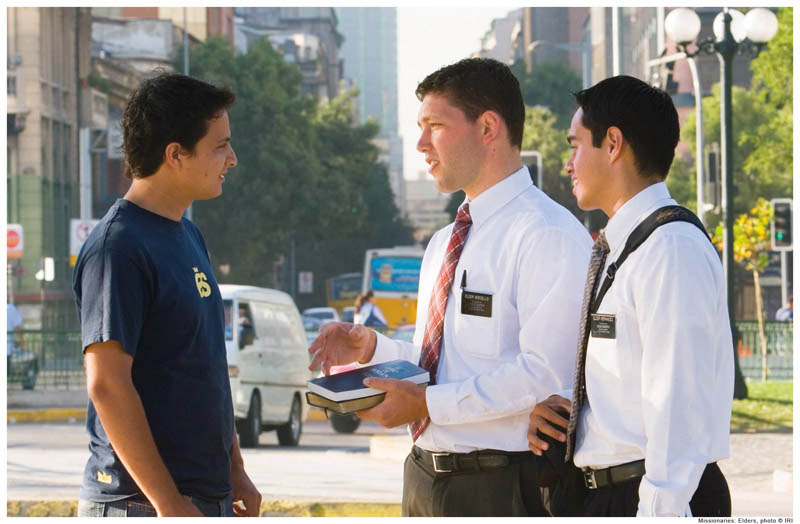
Before a child or adult is baptized, he is prepared for the experience. No one can walk into a Mormon Church and say, “I know nothing about you, but can I be baptized and then join your church today?” We expect potential converts to study and understand what they are signing up for and then to pray to know it is what God wants them to do. Children raised in the church are taught at home and in church classes. People nine years old or older meet with the missionaries for a series of lessons or discussions in which they are taught the basics of the religion and learn how to pray for their own testimony. In addition, of course, they attend meetings.

Prior to baptism, a person who has gained a testimony and has accepted an invitation for baptism is interviewed to be certain he is morally worthy and has prayed for his own testimony. Since baptism washes away sin, the person about to be baptized must go through the repentance process first and the person doing the interview simply makes sure it has been done and that the person is ready for baptism. The interview is confidential.

The baptism is usually held on a Saturday afternoon or Sunday after church, although it can be held on other days. The people being baptized are dressed entirely in white, usually a jump suit for modesty and easier ability to get everything under water at once. Those who come to watch the baptism (non-Mormons are welcome) gather in chairs. A hymn and opening prayer are offered. There are normally two speakers, one speaking on baptism and one on the Holy Ghost. After the talk on baptism, the person enters into the font, as does the priesthood holder doing the baptism. This can be any man age sixteen or older who holds the priesthood. Children are usually baptized by their fathers, but it is not a requirement. (After all, Jesus was baptized by his cousin, not God or Joseph.)

The priesthood holder says the baptismal prayer and lowers the person under the water. Everything must be underwater at the exact same time. Two witnesses stand on either side of the font and make sure the prayer is said correctly, since it is one of the few prayers with exact words. They also make sure the person is completely under water for a moment. If not, the baptism is redone.

Then both people go into a restroom to dry off and change clothes. While this happens, there is usually a brief movie or perhaps the sharing of testimonies. When the two who were in the font return, a talk is given on the Holy Ghost. Often a church leader and representatives of auxiliaries the person will belong to welcome them formally.

The person can be confirmed and receive the Holy Ghost that day, but it is usually done a week or two later during regular church services.

This involves a group of priesthood holders who are about eighteen or older gathering around the recently baptized person, who is seated in a chair. They place their hands on the person’s head. One person, chosen by the newly baptized person, confirms him a member of the church and commands him to receive the Gift of the Holy Ghost.

Why People Become Mormons: Mormon Family

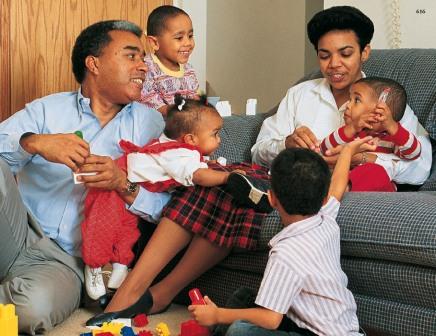
In this series, we’re looking at the reasons people first start looking into Mormonism. By the time they are ready to be baptized they have deeper reasons, including a testimony, but initially, they normally begin searching for a church to join because their lives are lacking something they feel a church might be able to provide. In this article, we’re discussing how Mormon beliefs about family appeal to many searchers. The Mormon family has a unique focus.

The Mormon family considers family to be sacred.

“In the Church, our belief in the overriding importance of families is rooted in restored doctrine. We know of the sanctity of families in both directions of our eternal existence. We know that before this life we lived with our Heavenly Father as part of His family, and we know that family relationships can endure beyond death.

If we live and act upon this knowledge, we will attract the world to us. Parents who place a high priority on their families will gravitate to the Church because it offers the family structure, values, doctrine, and eternal perspective that they seek and cannot find elsewhere.” (M. Russell Ballard, “What Matters Most Is What Lasts Longest,” October 1, 2005). Read more

Why People Become Mormon: Helping Their Children

Part one of a series

A new report from the Council of Churches states that while most church membership numbers are declining, Mormon membership is growing.  Mormons are the fourth largest religion in the United States and the church with the highest growth among the top ten this year and second among all churches reporting numbers.

Mormonism has a lot to offer teens and children

Mormonism has a lot to offer teens and children.

Mormonism isn’t an easy church to join. You have to participate in a series of “discussions” about the church first and complete assignments designed to help you learn what you’re signing up for and to help you find out if the Mormon Church is true. To this end, you are required to pray and ask God to tell you, since God is the one source you can always trust when you want the truth. You are then asked to commit to living specific Gospel principles and to live a moral lifestyle.

Then, if that’s not enough, you’ll probably get put to work. The Mormon religion is a lay church, so we don’t have paid ministers, organists, or other workers. This means everyone pitches in to help with one or two tasks. For instance, I assist a toddler with a disability in the toddler nursery each week.

Read more

Freedom of Religion

dallin-h-oaks-mormon-apostleElder Dallin H. Oaks, an Apostle of The Church of Jesus Christ of Latter-day Saints, gave an address on freedom of religion at the Chapman University School of Law on February 4, 2011.  In this address, Elder Oaks said that all organized religions need to band together to protect the religious freedom guaranteed in the United States by the first amendment to the Constitution.

Many people don’t realize that the goal of the first amendment guaranteeing freedom of religion is meant to keep the U.S. government from forcing a state religion upon the people (as had been done in Europe, causing many to seek religious freedom in America).  The founding fathers meant to give religion an honored, protected, and necessary place in American society.  John Adams said,

“We have no government armed with power capable of contending with human passions unbridled by morality and religion.  Avarice, ambition, revenge, or gallantry, would break the strongest cords of our Constitution as a whale goes through a net.  Our Constitution was made only for a moral and religious people.  It is wholly inadequate to the government of any other” (CHARLES FRANCIS ADAMS,THE WORKS OF JOHN ADAMS,SECOND PRESIDENT OF THE UNITED STATES,228–29; Books for Libraries Press, 1969).

In public discourse, the country’s leaders have begun to substitute the phrase, “freedom of worship” for “freedom of religion.”  They are not the same.  Freedom of worship is the right to meet at church, synagogue, or mosque.  This right to worship is a blessing, but keeps religion behind closed doors and in the private lives of believers.  Freedom of religion protects not only the right to teach the tenets of religion to religious followers, but the right to express beliefs in the public square, to vote according to conscience and to attribute moral choices to immutable laws created by God.

Things are turning inside out.  More so than ever, morality is attributed less to God and more to personal choice.  A pastor who cites the Bible to call homosexual activity a sin, offends those who feel it is their “sexual right” to engage in it.  This preaching makes them “uncomfortable,” and in their desire to justify their behavior, they want to quiet the pastor.  By creating a civil right to justify their behavior, the pastor becomes the transgressor against them, and traditional morality is turned on its head.

Morality is not situational, and religious people have the right not only to worship, but to express their religious beliefs, to vote according to conscience, and to seek to uphold the  Judeo-Christian moral basis of American society.

*More about Dallin H. Oaks’ address

*An interview with Dallin H. Oaks

*The full transcript of the address