Mitt Romney’s Mormonism
Mitt Romney is expected to announce tomorrow that he is running for the office of the President of the United States. Much has been made of his religious background and many wonder what impact his religion might have on his term of office if he’s elected. In this article, we’ll look at his religious background and how his experiences as a Mormon (the nickname for people who belong to The Church of Jesus Christ of Latter-day Saints) might affect his political leadership. We’ll also examine whether or not his presidency would give power to the Mormons, as some have speculated. Since this is a religion blog, not a political one, this article is meant only to inform readers about the religious background of Mitt Romney.
Romney comes from a long line of Mormons. His wife, Ann, is a convert. Romney was raised in an active, participating Mormon home and religion was a natural part of his daily life. Read more
Why Mormons Do Missionary Work?
Filed under: Basic LDS Beliefs, Discipleship: Following in the Savior's Footsteps, Finding Happiness, Finding Truth, Gospel Principles, Practices & Precepts, Jesus Christ, LDS Practices, LDS Q&A
A personal response
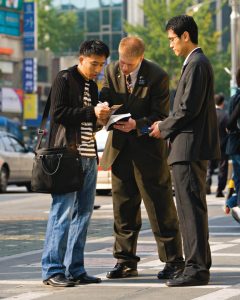
Most people are familiar with the sight of Mormon missionaries riding bikes, walking the neighborhoods, or knocking on doors. The men are dressed in suits, white shirts, and ties. They have short hair. The women are in dresses or skirts that fall below the knee. Most are young adults, but some are retired couples. And Mormons don’t wait to get called on missions. Many of them just love to share their beliefs with other people.
The correct name for the Mormon church is The Church of Jesus Christ of Latter-day Saints. Mormon is just a nickname once given Mormons by their enemies, but which Mormons themselves good-naturedly use, on occasion. The centerpiece of the church name explains the love Mormons have for missionary work. It is Jesus Christ’s church and the Bible commands us to share His gospel. Read more
Mormon Conversion
Filed under: Basic Beliefs of Mormons, Becoming More Christlike, Blessings, Discipleship: Following in the Savior's Footsteps, Finding Happiness, Finding Truth, Fruits of gospel living, Gospel Principles, Practices & Precepts, Making Decisions, Obedience, Recognizing Truth
Although anyone can attend most Mormon services and activities without being a member, conversion is required to experience everything the Church has to offer. Mormonism is actually a nickname for The Church of Jesus Christ of Latter-day Saints and the principles of Mormon conversion are based on the teachings of Jesus Christ, whose mission is as central to Mormonism as His name is to the true name of the Church.
A book called True to the Faith: A Gospel Reference, which offers introductions to many Mormon principles, explains that conversion is not an event in Mormonism. It is a process. Simply announcing that we accept Jesus Christ as our Savior does not complete the process. Gaining a testimony that The Church of Jesus Christ of Latter-day Saints does not complete the process. Nor does baptism or confirmation as a member of the Church. Conversion, for a Mormon, is a life-long process, and even an eternal one. It may be why Pew Foundation studies often show Mormon teens and adults score higher than many other religions in various aspects of religiosity. An understanding that conversion requires constant effort and strengthening will naturally lead one to work harder at keeping the commandments, studying, praying, and improving faith. Read more
Ezra Booth and the Dangers of Gossip
Filed under: Doctrine & Covenants, History, Joseph Smith: Mormon Prophet, Making Decisions, The Prophet
Ezra Booth, a former minister, became a member of The Church of Jesus Christ of Latter-day Saints, whose members are often called Mormons, in 1831, when the church was still new. He had seen Joseph Smith heal the arm of a church member, and this was his reason for joining. However, Mormons know miracles don’t really convert people. The miracle must be followed up with appropriate steps to gain a true testimony, including study and prayer. However, Booth did not do this and so he had only the single miracle to bolster his thin faith.
In the early days of the church, adult men, even those married, could be sent out on missions and often did so when they were quite new to the church. This is not the case today, where missionaries must be well-versed in their religion and have strong testimonies. Ezra Booth left on his mission only a few months after joining. This mission demonstrated his lack of true testimony as he faced his first necessity to sacrifice for his faith. He was angry over having to walk to his destination instead of being given transportation, even though the young church had no money for such things and neither did he. He began to feel upset that he didn’t see a continual stream of miracles, not understanding that miracles are miracles precisely because they are rare. Missionary work wasn’t the glamorous task he expected it to be.
The Mormon Relief Society
Filed under: Discipleship: Following in the Savior's Footsteps, Women, Women of the Church, Women's Issues
Relief Society is the official women’s auxiliary for The Church of Jesus Christ of Latter-day Saints. Members of this church are sometimes called Mormons because they accept the Book of Mormon as scripture, a book that testifies of Jesus Christ and is a companion book to the Bible.
The official handbook for The Church of Jesus Christ of Latter-day Saints explains the purpose of Relief Society:
Relief Society prepares women for the blessings of eternal life by helping them increase their faith and personal righteousness, strengthen families and homes, and help those in need. Relief Society accomplishes these purposes through Sunday gospel instruction, other Relief Society meetings, visiting teaching, and welfare and compassionate service. (See Handbook 2: Administering the Church.)
Relief Society began in 1842 when the women of the church told Joseph Smith, their first prophet and president, that they wanted a woman’s organization similar to those that were fashionable all around the country. He told them he had a better plan for them, one planned for them by God Himself and lost in the Great Apostasy. He helped them organize the Relief Society and told them the church had not been fully organized until the Relief Society began. It was to become a critical part of God’s plan, it’s motto, Charity Never Faileth, guiding its members in their work.
Julie B. Beck is the current president of the world-wide Relief Society. This places her in leadership over millions of women in diverse settings. Local branches of the organization have local leaders who report to stake (regional) leaders. Leadership of the Relief Society is also held by women at all levels.
Julie Beck explained:
We work in partnership with priesthood leaders, who hold keys which give them authority to preside in the name of the Lord. We operate in the manner of the priesthood—which means that we seek, receive, and act on revelation; make decisions in councils; and concern ourselves with caring for individuals one by one. Ours is the priesthood purpose to prepare ourselves for the blessings of eternal life by making and keeping covenants. Therefore, like our brethren who hold the priesthood, ours is a work of salvation, service, and becoming a holy people. (See Julie B. Beck, Relief Society: A Sacred Work.)
The Relief Society has a number of elements that help it carry out its purpose. Each Sunday Mormons hold church for three hours. They have a standards worship service, and two sessions of classes. One class is Sunday School, with men and women together. For the final classes, men and women meet separately. The women have Relief Society, where they discuss the gospel from a woman’s point of view. They learn how to apply the gospel in their everyday lives and lessons are personalized to the individual needs of the class. Classes are taught by women who are called (chosen) to teach.
In addition, Relief Society groups hold periodic meetings on other days. Some small groups form based on special interest, such as literature, self-reliance, or parenting. If a woman has an interest in forming a group, she can talk to her Relief Society leaders, which means the groups can have endless diversity. Once a month most Relief Societies also hold larger classes for all women. These are often a combination of spiritual and practical knowledge. Over the years I have learned some of the following skills in various Relief Society meetings: car repair, plumbing, cooking inexpensively, sewing, family history, gardening, languages, home education, blogging…the choices are as varied as the women who belong to the organization. In addition to lessons, many Relief Society meetings also involve humanitarian work.
Service is, of course, a primary component of the Relief Society organization. One popular part of the program is the literacy program. The literacy leader must be a woman, since she must be a member of the Relief Society, although men may receive the training and may also teach under the direction of the female leader. Literacy takes many forms, based on the needs of the individual congregation. If someone needs to learn to read, he or she may be taught by a private tutor. If there are multiple students who want to learn to read, a class is organized. Once students have completed the class, they can teach others to read, serving as both a teacher and a role model for students, who will be able to have a teacher who has been there.
During my time as literacy leader, I oversaw an English as a Second Language program and a citizenship preparation class. We also organized a blogging club, since in today’s world, blogging is one type of literacy. Other programs might help parents raise readers, teach journaling or personal history writing, improve computer skills, or conduct a literary book club. Some conduct homework help programs for children. Each congregation chooses the focus that best suits the needs of its members.
Another service program carried about by the Relief Society is Visiting Teaching. Women, working in pairs, are assigned several women to visit each month. They develop a friendship with those they visit and, when that woman needs help, she has two people she can call on. As a person who moves often, I can testify to the value of a visiting teacher. The first time I lived far from any family was pretty overwhelming. One day I needed help but because I was new, I just didn’t feel I knew anyone well enough to “bother” them with a request for assistance. As I stood in my kitchen, worrying about what to do, I noticed on my refrigerator a small poster with the names and numbers of my new visiting teachers, with a plea to call them first on the bottom of the note. Relieved, I picked up the phone and reached a visiting teacher who was thrilled that I had felt comfortable enough to ask her for help.
Years before that, my father was diagnosed with a brain tumor. His emergency surgery was being held some distance away and I needed to be there. However, I was in the process of moving out of state and my husband had already gone ahead to get his new office in order and to find a home for us. I had no idea how to organize the millions of details of my suddenly complicated life. To make matters worse, my visiting teacher (I only had one at the time) had just moved and I hadn’t been given a new one yet. Then a knock came at my door and three women stood there. They were the women I was assigned to as a visiting teacher. They had heard of my plight and on discovering I had no visiting teacher, they had decided to turn tables and be my visiting teachers for the last month I would be living there. They had already set up transportation for my children so they could get to their meetings and activities and found child care for me while I was out of town. When I returned to retrieve my children, dinner was waiting for me and someone had even given the children their allowances since I was gone on allowance day! Visiting teaching builds a web of friendships that can be a lifesaver, sometimes literally, since an elderly woman living alone will have someone checking on her regularly.
Each Relief Society has a compassionate service leader. This woman oversees all the service needs for the women—and sometimes the men—in the congregation. If the visiting teachers become aware of a need that is too big for them to handle alone, they pass the information on to the compassionate service leader to handle. That leader will ask for volunteers to step in and help out. Typical service includes bringing in meals to families that are sick or grieving, cleaning homes when a family is moving out, picking up children in an emergency, checking on an elderly person daily, and taking people to doctor appointments.
Next week we’ll look at how Relief Society impacts the Mormon view of womanhood.
What Mormons Believe About Christian Judgment
Filed under: Basic Beliefs of Mormons, Gospel Principles, Practices & Precepts, Jesus Christ
There are times when the Bible can seem confusing because it appears to give conflicting advice. One such situation concerns the topic of judgment. The Bible tells us we must not judge others unless we ourselves want to be judged, but it also offers a variety of situations in which we’re told to make judgments. What is a person supposed to do if he wants to obey all the commandments?
On March 1, 1998, Dallin H. Oaks spoke to college students at Brigham Young University on this topic. His talk is called, “”Judge Not” and Judging.” He is an apostle for The Church of Jesus Christ of Latter-day Saints, whose members are often called Mormons. His title within the Church is Elder Oaks. It is particularly interesting to note, given the topic of the talk, that prior to becoming a Mormon apostle, Elder Oaks was a judge, even serving on a state Supreme Court.
Elder Oaks explains the conflict is the result of having two types of judgment. The first is final judgment, which God does not allow us to make. This is the source of the commandment to avoid judging. The second is intermediate judgment. We can make this type of judgment, but we must make it righteously.