
Why are Mormons Called Mormon?

September 24, 2011 by · Leave a Comment
Filed under: Book of Mormon 

I recently read an article in which the author said Mormons worshipped Mormon and Jesus both, which he felt proved Mormons aren’t Christians. The writer hadn’t done his homework. Mormons—a nickname sometimes given to members of The Church of Jesus Christ of Latter-day Saints—do not worship Mormon. They believe he was a real person, but he was a prophet, not a god and Mormons think of him in the same way they think of Moses or Noah. His story is an interesting one that illustrates a true Christian life. However, the true name of the Church defines whom we really worship.

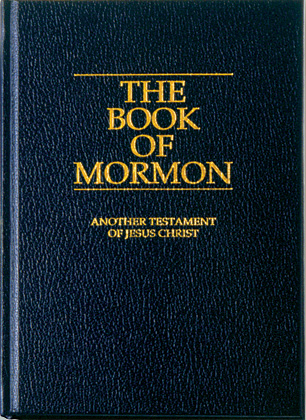
Book of MormonThe misconception comes from the title of a book of scripture Mormons use in addition to the Bible. It is called the Book of Mormon and is a second witness of the divinity of Jesus Christ. Because the events described in it largely took place somewhere on the American continent, it helps to prove Jesus really did live and that He really was resurrected, since He visited them after His death. It makes it clear Jesus was not just the Savior of a tiny group of Christians in the Holy Lands, but of all people everywhere.

The book is named after Mormon not because the book is about Him, but because he, and after his death, his son, condensed the writings of the prophets who contributed to the book and put it into the form Joseph Smith received from Mormon’s son Moroni, who was by then an angel. Because the Book of Mormon is so well-known, non-members started calling members of the Church of Jesus Christ of Latter-day Saints Mormons—and sometimes we do it ourselves, although it isn’t really the correct name.

When Mormon was ten years old, a prophet named Ammaron hid the records in a hill. Each prophet had been required to write a history of his people and their dealings with God. Now a war was about to start and they needed to keep the records safe. Ammaron went to Mormon and said, “I perceive that thou art a sober child, and art quick to observe.” He instructed Mormon to retrieve the records from their hiding place when he was twenty-four years old. In the meantime, he was to pay attention to the history of his people so that when he got the records, he could add to them. Since these records were kept only by prophets, this was effectively his call to be the next prophet. However, he was only to take one set of records and leave the rest. These records were engraved on brass plates.

At the time Joseph Smith translated the Book of Mormon, it was believed ancient people had not kept records on metal plates. Today, records kept on metal plates have been found and dated into ancient times.

When Mormon was eleven, his family moved to a place called Zarahemla. The wars began and the people became very wicked. At age fifteen, Mormon, still a serious young man, wanted to preach to the wicked, but God would not allow it. They were too wicked and would not have listened to him. In fact, such preaching might have put him in danger and prevented him from carrying out God’s plan for Him.

The next year, even though he was only sixteen, he was chosen to lead his people in battle. He was tall for his age and an imposing figure. The battles didn’t always go well. The people had been promised they would always be protected when they obeyed God, but Mormon’s people, the Nephites, did not, so their enemies, the Lamanites were able to experience some success. Mormon worked to get all the Nephites gathered into one place so it would be easier to protect them.

In time, the Nephites became frightened by the wickedness of the world and began to express sadness over the ways of the world. Mormon was overjoyed by this, being not just their military leader, but also a spiritual leader. He hoped, with the optimism of  youth, that they were sad for their own contributions to the world’s evil, but he soon realized they were only unhappy God wasn’t protecting them in their wickedness. They were not interested in repenting, only in getting protection they didn’t deserve any more than their enemies did. They wanted God to make them happy while they continued to sin.

In time, they were forced to flee, and as Mormon reached the age of twenty-four, the age he was commanded to retrieve some of the records, he found himself near their hiding place. He dug up the records and recorded the wickedness and trials of his people.

He continued to lead his people in battle, but he noted that they were rejecting the opportunity to have God’s help. However, they eventually managed to work out a treaty with the Lamanites and regain some of their lands and did so with God’s help, despite their unworthiness. With a ten-year break in the fighting, Mormon helped them prepare for the next battles, and tried to help them understand they survived only because God stepped in. They didn’t see things that way, however.

When war began again and the people began bragging they were winning entirely due to their own brilliance, Mormon decided he’d had enough. He refused to lead them any longer. They were unwilling to repent and to live the gospel of Jesus Christ. Year after year, the Nephites battled the Lamanites. Finally, when Mormon, still an observer and their prophet, even though they were ignoring him, saw the city was about to be overtaken, he returned to the hill and retrieved all the records to protect them. At this point, Mormon agreed to once again be their military leader.

At this time, a great battle was scheduled between the two groups. Mormon, now growing old, understood it would be the final battle and the end of a once-great civilization. He was, remember, a prophet. He completed the records and hid them in the Hill Cumorah because God had commanded him to protect them from the Lamanites, who wanted to destroy them. He gave a few plates to his son, Moroni, but the rest were hidden.

The majority of the Nephites, once God’s people, were killed in this battle. Those who survived were forced into hiding, but one by one, they were found and killed. Eventually, Mormon was killed.

In time, his son, Moroni, was the last remaining Nephite, the only good person left in his part of the world. The Lamanites had become evil beyond measure and were focused entirely on murder, even of their own people. Hidden away, the teenage Moroni worked to condense the records to manageable size and then hid them away. He fled and traveled for many years. Eventually he secretly returned and added more to the record before again hiding them and leaving. His story, which he shares in the Book of Mormon, is one of the most moving stories ever written, that of a teenager who has lost his entire family and all his friends and who remains alive only to do God’s work.

Although you might not have heard of Moroni, you may have seen the angel of the statue that appears atop most Mormon temples. This is a representation of Moroni, who would return as an angel to tutor Joseph Smith prior to the restoration of the gospel and who would lead Joseph to the records for which he paid such a great price.

Exploring Mormon History: The Mormon Battalion Visitor’s Center in San Diego

September 16, 2011 by · Leave a Comment
Filed under: Mormon History 

Looking for something free, air conditioned, and fun to do in Old Town, San Diego? A year ago, the Mormon Battalion Visitor’s Center was renovated to make it a destination praised by Mormons (the nickname sometimes applied to members of The Church of Jesus Christ of Latter-day Saints) and non-Mormons alike. The twenty-minute tour takes visitors back into San Diego’s early history, which played a pivotal role in Mormon history as well. The religious aspects of the tour are minimal and there is no effort to convert visitors. If they want to learn more about the Mormons, they can fill out a request card or ask questions on their own. Otherwise, the focus is on the historical events.

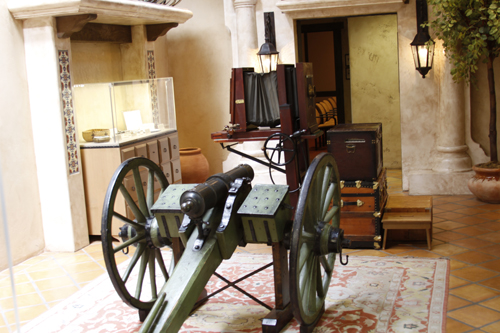
Mormon Battalion Visitor's Center Mormon HistoryThe visitor’s center is hosted by Mormon missionaries in period clothing. Visitors “travel” with the Mormon Battalion to explore this part of Mormon history by moving from room to room, sitting on logs, benches, or rocks during presentations to make it more real. Videos in each room are cleverly designed to provide an interactive feel to them. In the first room, you’re welcomed by missionaries and have a chance to see photographs on the wall of some of the participants in the events—men and women, and even one child. Unexpectedly, the people in the photographs begin to talk, Disneyland-style. The tour guide invites one of them, a teenager who talked his way into the Battalion despite being underage—to tell his story. In another, a window is suddenly revealed to be a video screen as one of the actors knocks on the window and proceeds to tell you more about his story. In a pioneer shop, guests are shown what each soldier was given in the way of supplies and one is dressed in the outfit. Everyone is invited to hold the musket, which is startlingly heavy. Missionaries chat with the actors on-screen to provide an entertaining historical lesson.

At the end of the formal tour, visitors may view a variety of artifacts and displays and may have their photo taken in a Battalion setting (without costumes.) Each visitor receives a printed photo and the option of having it emailed to them as well. An outdoor area is very child-friendly and hands-on. Children—and even adults—may pan for fool’s gold. There are stick horses, costumes, and other activities for the children to try out. A trip upstairs gives you a lovely view of Old Town and the displays point out the other historic sites in the area. This is a fun way to learn Mormon history without pressure, textbooks, or tests.

The Mormon Battalion is a unique segment of Mormon history. It was formed while the Mormons were on their way to Utah. Prior to the trek west, they had learned that freedom of religion had serious limitations and that the Constitution, at that time, did not allow the federal government to prevent states from ignoring the Constitution’s laws. This would be remedied after the Civil War, too late to help these early Mormons. As a result, there were no real consequences for mobs that attacked, robbed, tortured, and even killed Mormon men, women, and children. In Missouri, the governor issued an extermination order on the Mormons who lived in his state. With this passage, mobs were free to do whatever they wanted to do to the Mormons, and their leader, Joseph Smith, was murdered, as were other Mormons. The Mormons were forced out of several states in these early years, including Missouri, Ohio, and Illinois.

With all this sad Mormon history behind them, and with many having been forced to give up their homes and possessions and even their families again and again with no support from a president who had made it clear it wasn’t in his best political interest to intervene, it was naturally upsetting to many Mormons when a delegation from the United States Army arrived at one of the Mormon pioneer camps. He approached the camp leader and said the president wanted Mormons to enlist in the war against the Mexicans.

Most felt the government was out of line running to them for help when their own pleas for help had gone unanswered. They also wondered how their wives and children would manage the long trek and the initial work of settling a new land without them. However, a message was sent by the camp leader to Brigham Young who arrived at that camp with the military leaders. He helped his people to understand the money the soldiers would be paid would help their families purchase desperately needed food and supplies. It would also show the government the Mormons were good Americans, even if they had been forced out of the country by that same government. (They were currently in Iowa, which was not yet a part of the United States.) He prophesied that they would face no fighting and promised to have their families watched over. With Brigham Young’s encouragement, 541 soldiers enlisted. In addition 35 women accompanied them, most as laundresses. These women brought with them 42 children. The company also included one nine-year-old boy, Charles Colton, who slipped away from camp because he wanted to serve with his father. Because no one was available to return him, he was allowed to stay.

The Mormon Battalion marched 2000 miles to San Diego, one of the longest military treks in history. During the journey they built roads others would be able to use in the future. The rations provided them were insufficient and they were often extremely hungry and thirsty. They had chosen to send the money from their clothing allowance back to their families, so they were insufficiently clothed, as well. Since the women and children had no rations, they had to be cared for from the meager rations the men were given, further depleting their supplies.

Mormon Battalion Visitor's Center Mormon HistoryBrigham Young’s prophecy came to pass. The only shooting done on this journey was to defend themselves against a cattle stampede, in what humorously became known as the Battle of the Bulls. However, twenty men died from poor nutrition, sanitation conditions, and thirst. There was an enormous amount of suffering. They were forced to march with a regular army group led by the same man who had forced them out of Missouri and this man, Colonel Price, refused to share rations until forced to do so. (The regular Army was better provisioned.) They were assigned a doctor who believed calomel and arsenic were the cure for everything, and these he served on one rusty spoon to be shared by all. Since these “cures” were poisonous, the dosage was quite dangerous to those forced to take it.

Only 339 people made it all the way to San Diego. The longest trek in military history—and one of the longest in Mormon history—ended in California, many arriving barefoot because their shoes had long since worn out.

Although they had been sent to fight the Mexicans, once they arrived, they, in typical Mormon fashion, settled in for a while to help the Mexicans build their city. They helped build the first courthouse, some of the roads, and other buildings in what is now Old Town. Little Charles Colton’s father and three other men made 40,000 bricks that were used in the building process. Officially, they were occupation troops, but they established a good relationship with the local people.

When their one-year enlistment ended, eighty-one men re-enlisted. Most of the remainder headed for San Francisco, intending from there to head for Salt Lake City, Utah. However, a church leader delivered a message from Brigham Young asking those who did not have families in Utah to stay and work. The income was much needed. Many did so and so some were participants in the discovery of gold at Sutter’s Mill. Other men observed the irrigation process used by immigrants, a skill they took home to use in the famous irrigation of Utah, bringing water to the desert.

While the formation of the Mormon Battalion brought hardships to both the men and their families, Brigham Young was inspired in his decision to encourage the men to put aside their anger and hurt at the way their government had treated them. The trek allowed them to earn much needed income to assist Mormons in making the journey to Utah, taught them valuable skills, and sent a clear (although often ignored) message that Mormons were loyal Americans despite their rejection by their nation. It was a critical time in Mormon history, one that impacted both the nation and the small group of religious pilgrims headed for a promised land in Utah.

The Mormon Battalion Monument is located at 2510 Juan Street in San Diego, California, in the Old Town historic district. It is open from 9 AM to 9 PM, seven days a week, and is entirely free. (There is not even a charge for the photo and there is no gift shop or other means of spending money.)