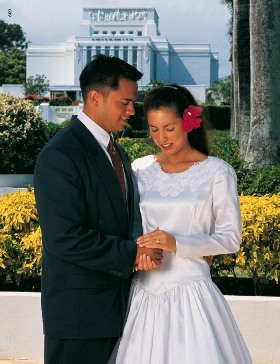
New Years Resolutions for New Mormons

December 26, 2008 by Terrie Lynn Bittner · Leave a Comment
Filed under: Surviving the First Year 

Congratulations! You’ve joined the Church of Jesus Christ of Latter-day Saints, and have become what is sometimes called a Mormon. Your whole eternity looks different now, but you may be feeling a bit overwhelmed about what steps to take next. With the new year just starting, it’s a great time to make some resolutions to help you settle into your new faith. Following are some ideas to get you started:

Mormon Temple 1. Read the Book of Mormon all the way through. If you’ve never read it, it will give you a strong foundation in your faith. If you’ve already read it, you’ll find new insights now that you’re a member and have the basics of the book under control. As soon as you finish, read the Bible.

2. Put your testimony in writing, and date it. Each year, on your baptism anniversary, write a new testimony. Keep them all together in a notebook so you can see how it grows. In each one, record the parts of the gospel that have the most impact on you and at least one spiritual experience that helped your testimony grow.

3. Start a journal. Record your everyday life, but also record your growing testimony and gospel experiences. Someday all this Mormonism will seem ordinary to you. You don’t want to forget what it was like when it was new and exciting. Remembering will make you a better missionary to others and also help you to remember why you joined when the going gets rough.

4. Prioritize the changes you want to make. As you prepared for baptism, you made a number of changes in your life to qualify for your baptism. Now you may have learned many more things you will need to do in your lifetime to become the person you want to be. This can be very overwhelming. Don’t try to change everything at once. Make a list of ten things and put them in order of most important. Start with those that have the most impact on your spirituality and worthiness and work on one or two at a time. When you feel those are under control, choose two more. In the long run, you’ll make more changes this way than if you try to do twenty things at once.

5. Make an LDS friend. You need someone you trust, besides the missionaries, to turn to when things are spiritually challenging, when you’re asked to give your first talk, or when you don’t understand something. Take your time, and choose wisely. This person can serve as your mentor, so you want to be sure they have a strong testimony and lots of patience. Often people who are also converts have the easiest time understanding how confusing all this is for you.

6. Find a way to serve. Even if no one offers you a calling, find something you can do. Let the bishop know you’d like a church job, but also look for those little things that always need doing that no one is assigned to do. Come early and straighten the hymnbooks. Make a point of greeting visitors. Bring the missionaries a regular treat. Sit by someone who always sits alone. The church is full of jobs that don’t come with callings, and you can assign yourself one or two of them.

Changing the Music in Your Home

December 26, 2008 by Terrie Lynn Bittner · Leave a Comment
Filed under: Music 

Once we become aware of the power of music to influence our spirituality for good or bad, we often start to take inventory of the types of music in our homes. This leads to a need to remove some types of music and replace it with others. However, that can seem a bit overwhelming financially. How can we carry out the process of making our music pleasing to God?

Mormon FamilyThe first step is to identify what music needs to leave. Frequently, we’ve paid little attention to the message our music is sending us. While we don’t have to restrict ourselves to religious music, we do have to be certain the music isn’t placing into our minds messages that counteract those God is placing in our minds through the spirit, and that our music isn’t chasing away the spirit. This means we’re going to have to listen to our music, paying attention to the words and the overall message, and also to how the music itself makes us feel. If the music is too hard-hitting, you may feel God’s Spirit leaving the room.

Depending on your media, you may be able to save specific songs that are fine, while deleting those that aren’t on any given piece of media. Otherwise, you’ll need to remove the entire CD or other media, so the songs that are inappropriate are gone.

If you have teenagers, you might offer them a budget you can afford to help them replace inappropriate music. You don’t have to replace everything at once. This can be a long-term project.

Of course, this leaves the family a bit short of music for a while. Fortunately, there are many free or inexpensive sources of music to help supplement the current collection. Radios carry music, although they may not be reliably safe and listeners may have to stay on guard and be ready to change the station. Many websites now allow you to download single songs inexpensively, so you can choose just the music that is appropriate. While it may not be the cheapest way to buy a complete CD, it is one that allows you to have good music, and avoid that which is inappropriate. Doing it this way also sends a message to the artist. If the morally clean songs sell better than the immoral ones, more appropriate music will get made.

Libraries often carry music that can be borrowed. This allows the family to have consistently changing music for variety. Family members can also trade with each other for a little more variety.

Some radio stations focus only on appropriate music. For instance, Brigham Young University, which is owned by the Mormons, has two stations, one for instrumental music, and one for other music and sermons. The music on these stations is spiritual in nature, and therefore morally clean.

Using morally clean radio stations and libraries allows you to find new artists who are more reliably moral than those you may have listened to in the past. It is helpful to discover artists you can trust to uphold your values, so you don’t have to carefully research each purchase, or find yourself the owner of something you don’t want to own. For instance, the Mormon family, the Five Browns, are popular with people of all faiths and are reliably safe.

The new year is a good time to set a music resolution—from here on out, only music you would play for the Savior will be welcome in your home.

Christmas Service the Savior’s Way

In this year’s Christmas devotional, the president of the Church of Jesus Christ of Latter-day Saints, (nicknamed the Mormons), Thomas S. Monson, talked about the innkeepers who turned away Mary and Joseph as they sought a place for Jesus to be born. He thought that later, the innkeeper might have been sorry, and might have chosen differently had he known who the baby was to be. But he didn’t get a second chance. Jesus Christ was born and the opportunity to serve was over.

Mormon Temple on Christmas TimeIn Jesus’ own life, he never missed a chance to serve another person. When someone needed healing, or a blessing, or words of wisdom, he stopped and took care of it right then. He didn’t just preach service; he lived it.

The Bible tells of a group of children who were brought to see him. It was at the end of a long day, and the Savior was tired. His apostles tried to send the children away, but Jesus stopped them. He called them over and spent time with each child, serving them and showing them love. He had just one chance to show the children what the love of the Savior meant, and to serve them, and He took it, even though He was tired.

Recently I wrote about a blind man who called for Jesus’ attention. The others in the area tried to stop him, because he was unimportant in the world’s eyes, and they felt he shouldn’t bother someone as important as the Savior. However, he wasn’t unimportant to the Savior, who called the man to him and spoke to him politely, asking how he could help. He didn’t turn away because the man wasn’t important to society. He just served because service was needed.

Jesus Christ came upon a woman being stoned for adultery. She was certainly a sinner, but Jesus didn’t worry about that. He stopped the men about to stone her and refused to judge her. His service likely saved her life. However, he gave her an even more important gift—he instructed her not to sin again. He didn’t accept her behavior, or give her permission to live an immoral lifestyle. However, he didn’t allow men to mistreat her. He rescued her and then instructed her to forsake the sin.

Throughout Jesus’ brief ministry, he served all sorts of people, the rich, the poor, the valiant, the immoral, the kind and the not-so-kind. He looked for those who needed service and then served them without stopping to judge their worthiness.

In the Book of Mormon, a wise King named Benjamin said, “And also, ye yourselves will succor those that stand in need of your succor; ye will administer of your substance unto him that standeth in need; and ye will not suffer that the beggar putteth up his petition to you in vain, and turn him out to perish. Perhaps thou shalt say: The man has brought upon himself his misery; therefore I will stay my hand, and will not give unto him of my food, nor impart unto him of my substance that he may not suffer, for his punishments are just— But I say unto you, O man, whosoever doeth this the same hath great cause to repent; and except he repenteth of that which he hath done he perisheth forever, and hath no interest in the kingdom of God. For behold, are we not all beggars? Do we not all depend upon the same Being, even God, for all the substance which we have, for both food and raiment, and for gold, and for silver, and for all the riches which we have of every kind?” (Mosiah 4:16-19)

In this Christmas season, let’s remember the example of the Savior and not miss an opportunity to serve just because we didn’t realize how important it might be, or because we find the person in need beneath our notice.

Mormon Marriage and Family Relations Course

December 17, 2008 by Terrie Lynn Bittner · Leave a Comment
Filed under: Parents/Leaders, Teaching Values 

Mormons attend church three hours each week. After the basic service, they attend two other classes. In addition to the regular courses, there are optional courses offered periodically in wards (congregations) as needed. One is the Marriage and Family Relations Course.

Mormon Temple MarriageWhile taught from a Mormon perspective, students do not have to be LDS. The course textbook is available free online, which also allows others to learn the material even if it’s not offered in their areas. For those who do wish to take the class, the course is free. You can contact your local congregation to find out if it’s being offered.

The course consists of sixteen lessons. The first eight are about strengthening marriage. This is important because parents who care about each other and have a strong, functional relationship are better able to meet the needs of their children. The remaining lessons are about parenting.

Parents are taught that children are a gift from God. He created them and they are his children, entrusted to our care. That makes parenting a sacred responsibility. Both parents are essential to a child’s well-being and each parent plays a specific role in the child’s life. Parents are taught what those roles are and are given advice on how to fulfill them.
They learn how to teach their children through example, living their own lives the way they want their children to live theirs. They also learn how to talk to their children about those things that are important, including religion.

The course includes guidelines on types of moral instruction parents should focus on and suggests ways to teach them, such as honesty, hard work, and moral purity. They also learn how to help children understand that choices have consequences and they don’t get to choose the consequences.

The course then introduces some specific Mormon programs that are done in the home by the family to strengthen the family and teach the children. These can be adapted to any faith: family prayer, scripture study, and family home evening.

Family home evening is a program that asks families to stay home on Monday evenings and spend time as a family with no outsiders. They have a family meeting, consisting of prayer, songs, a lesson on a principle the family wants to develop (nutrition, service, morality and other issues, both spiritual and practical), a treat and a fun activity. In today’s busy families, this is critical to making sure families develop a relationship with each other.

This course is designed to help parents set meaningful goals for their families, so their parenting and family life is conducted with an overall purpose and focus, rather than just getting through the busy days. Each choice made is one designed to further the well-being and love of the family, and to help children grow to adulthood successfully.

While some of the material is, of course, specific to the Mormon religion, most of it is also generally good advice, and can applied or adapted to almost any family’s values, if those values are conservative and high.

To read the course materials, visit Marriage and Family Relations Class.

When Mormon Missionaries Knock on Your Door

December 10, 2008 by Terrie Lynn Bittner · Leave a Comment
Filed under: Today's Mission Field 

Most people have found Mormon missionaries standing at their door from time to time. Have you ever wondered what would happen if you invited them in?

Elder Mormon MissionariesTheir responsibility is to deliver a message to those who are interested. The message may vary, based on what they want to teach or what they feel inspired to discuss with you. For instance, they may have a message about how you can strengthen your families through a Mormon program called Family Home Evening. They may have a more doctrinal message for you. Whatever the message, it is brief and they will stay only as long as they’re welcome.

Generally, the first visit, particularly if they’ve arrived unannounced, is very brief and then they ask if they can return. Your answer is respected. When I was going door to door as a missionary, we kept records of where we went and were not allowed to return for one year unless invited. That way we didn’t become pests, but still gave people the opportunity to change their minds, and for newly arrived neighborhood members to meet us.

If you’re interested, but don’t have time for them just then, or perhaps want to wait until your spouse is home, ask if they can return. They’ll make an appointment to see you and even let you know how long they’ll stay if you’d like. Their purpose is to teach, not argue, so you should invite them back only if you’re sincerely interested in learning about the Mormons. You don’t have to plan to convert, but you should be a sincere seeker of truth, and not someone plotting a battle of wits. God’s servants are not supposed to argue.

The young people knocking on your door are volunteers. They have usually left their home, school, jobs, and families for eighteen months to two years because they feel strongly about the gospel message they’re sharing. They live under strict rules and have a great deal of structure, which helps them develop self-discipline and maturity. They come into contact with many people, which gives them an understanding of a diverse world different from their own hometown. They spend every waking moment with a companion of the same gender, and learning to live and work with another person helps to prepare them for marriage. They are regularly rotated, sent to a new area of the community and given a new companion, and as a result, learn to be adaptable. These are all skills that serve them well as adults during the rest of their lives.

You’ll find many of them are homesick and are happy to find themselves in a living room with a real family. You are under no obligation to feed them, although you can, but they will enjoy having your children in the room, participating in the lesson. The missionaries are prepared to share their message in a way even a child can understand.

If at some time, you change your mind about receiving the lessons they teach, you need only tell them. Most people, however, continue through the six lessons and visit the church to better understand a growing religion. They soon realize most of what they’ve heard about Mormons really isn’t true, and even if they choose not to be baptized, they come away with a better understanding of the religion they’ve long heard about.

Mormons Leadership in Congregations

December 10, 2008 by Terrie Lynn Bittner · Leave a Comment
Filed under: Church Organization 

The Mormons (members of the Church of Jesus Christ of Latter-day Saints), have a lay church, meaning the leaders are not paid. Everyone volunteers their time, which offers extensive opportunity for personal growth and the development of new skills. Leadership is chosen from among the membership and rotated often, giving many people the chance to learn to lead.

Mormon CHurch MeetingOrganizations are led by a president and two counselors. The president is under the direction of someone at a higher level of leadership, but has real authority within his “calling,” as church jobs are called. He must follow established guidelines and consult with his own leaders, but he can make decisions and each president brings to the organization his own style.

The president must make decisions through prayer and wisdom, while following church guidelines. He staffs the organization, sets goals, trains those under him, and makes certain everything runs properly and according to the rules.

The counselors advise the president as needed, giving him or her other points of view or ideas. They also assume portions of the responsibility. Generally, each person in the presidency is assigned a part of the work to be in charge of and this allows the counselors to also assume authority and learn leadership. They must respect the goals and wishes of the president however, who is the person to whom God gives the authority for the organization.

The presidency also has a secretary. In most organizations, the secretary attends the presidency meetings and is also considered a valuable resource for ideas and problem-solving.

Let’s look at one organization to see how all this works in practice. Since I’m most familiar with the Primary, we’ll use a Primary presidency as an example. The Primary is the organization for children ages eighteen months to twelve years of age. The presidency for this organization is always female, although men may serve in other positions in the Primary. This means the women oversee both men and women.

The president is chosen first, by the bishop and his counselors. (A bishop is like a minister.) She prayerfully selects two counselors and a secretary to assist her in her work. She submits the names she’s chosen to the bishopric (the bishop and his counselors) for their prayer and approval. The bishopric invites (calls) those people to the positions. Then the president meets with her new presidency to set goals for the coming year and to assess the needs of their organization. This is done in a presidency meeting.

One responsibility they face is to select teachers and leaders for the Primary, which includes not only the Sunday classes, but Cub Scouting and a similar program for girls called Activity Days. They prayerfully select people and submit the names to the bishopric, who, again, invites those people to take the positions if they’re approved by the bishopric. This approval from above is because getting a new job often involves releasing (letting go) them from another job, requiring the leaders of that organization to need new people. The bishopric must balance the needs of both organizations. The bishopric must also assess worthiness, particularly for people who will be working with children.

The Primary presidency decides on routines and schedules for Sunday meetings. They train their teachers and their leaders and work to create a supportive environment where teachers feel comfortable coming to them for advice when they need help solving problems.

In this case, the presidency also teaches. They take turns teaching a meeting called Sharing Time, where the children come together in multi-age groups for a participatory gospel lesson before or after going to age-assigned classes.

The presidency generally solves problems alone, but may always turn to the bishopric member assigned to oversee them if a problem is outside their ability to solve, such as a safety issue involving a child. In addition to the bishopric, they have a stake Primary presidency (a stake is similar to a Catholic diocese) they can turn to for their own training and counsel.

While the church runs on volunteers, no volunteer is left without resources to turn to as they need them. They learn leadership skills that transfer into the home or workplace while serving God.